
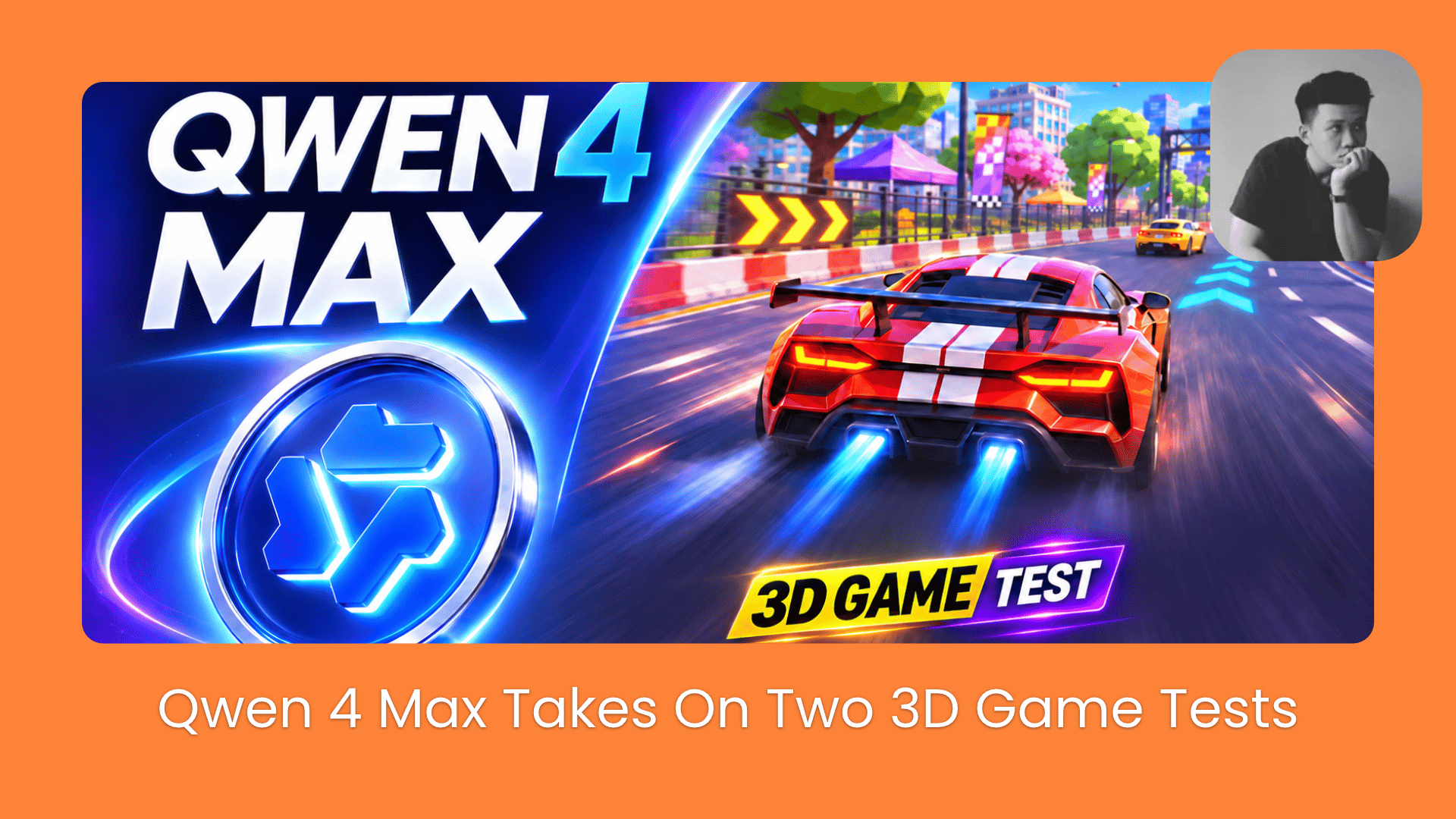
60% lower average task costs compared to Qwen3.8-Max. Can Qwen4-Max actually compete with GPT, Claude, and the world’s leading AI models?. .
TL;DR: Qwen 4 Max is a Mixture of Experts model with 2.4 trillion total parameters, 71 billion active per token, and a 1-million-token context window. Its benchmark results are strong in some areas, but vary by task.
Across 16 tests, it leads on several agentic and reasoning benchmarks, including Agents’ Last Exam and BioMysteryBench. It scores lower than competitors on Terminal-Bench 4.0 and ProgramBench.
The article also examines 3D skateboarding and racing game concepts, focusing on environments, controls, physics, and game systems.
2.4T total parameters; 71B active per token.
Strong results on selected benchmarks, weaker scores elsewhere.
Playable games still need hands-on testing.
Table of Contents
Introduction
How powerful is Qwen 4 Max in real-world use?
What we’ll cover:
-
The real specs, including the stuff the launch post buries
-
Benchmarks: the wins, the losses, and the ones to treat with caution
-
Token efficiency: Alibaba’s claim vs. what an independent lab measured
-
Two hands-on game builds with the exact prompts
-
API and subscription pricing, with a caveat on one number
I. What Is Qwen 4 Max? Specs, Architecture, and Key Features
Qwen 4 Max is Alibaba’s new flagship model, with 2.4 trillion total parameters, 71 billion active per token, and a 1-million-token context window. It’s a Mixture of Experts model that also handles images and video.
To test its real-world capabilities, I put it through two 3D game builds, a skateboarding game and a racing game, using Three.js, all from single prompts with no external assets.
The visuals are solid. Whether the physics and controls actually hold up is the part I’ll be honest about.
1. Qwen 4 Max Leads Several AI Benchmarks
Qwen 4 Max delivers strong results across several benchmarks, especially in agentic coding and specialized reasoning tasks.

Here are some of its strongest results:
-
DeepSWE v1.1: Scores 75.7, the highest among the compared models.
-
Agents’ Last Exam: Scores 46.7, ahead of Opus 5.5 at 43.4.
-
HLAB-Vals-1.1: Scores 21.3, well above Qwen 3.8 Max at 15.4.
-
BioMysteryBench: Scores 85.0, leading the comparison.
However, Qwen 4 Max still falls behind in some areas. On Terminal-Bench 4.0, it scores 48.5, while Kimi K3.1 reaches 67.2. On ProgramBench, Qwen 4 Max scores only 31.5, compared with 65.0 from Opus 5.5.
Overall, Qwen 4 Max performs well in several agentic and reasoning tasks, but it still has room to improve across other benchmarks.
2. Qwen 4 Max Gets Better Results With Fewer Tokens
One of the biggest improvements in Qwen 4 Max is its ability to achieve higher scores while using fewer tokens than its predecessor.

On Work360, Qwen 4 Max scores around 46.6 at Low, 48.1 at High, and 52.7 at X-High reasoning. Qwen 3.8 Max scores around 42.3, 43.6, and 47.7 at the same levels.
Terminal-Bench 4.0 shows an even bigger gap. At X-High reasoning, Qwen 4 Max scores 48.5 using around 154K tokens. Meanwhile, Qwen 3.8 Max scores around 37.8 and uses nearly 290K tokens.
This shows that Qwen 4 Max has improved its token efficiency on agentic coding tasks. It can achieve better results while using fewer tokens for reasoning.
Learn How to Make AI Work For You!
Transform your AI skills with the AI Fire Academy Premium Plan – FREE for 14 days! Gain instant access to 700+ AI workflows, advanced tutorials, exclusive case studies and unbeatable discounts. No risks, cancel anytime.
Start Your Free Trial Today >>
3. Qwen 4 Max Leads Across Four Efficiency Categories
Qwen 4 Max also performs well against Qwen 3.8 Max, GLM-5.3, DeepSeek V4 Pro, and Kimi K3.1 Pro across four categories: Knowledge, Code, QA, and STEM.

The chart uses a metric called 10 × BPB (Bits Per Byte), where lower scores indicate better results. Qwen 4 Max records the lowest scores across all four categories:
-
Knowledge: 4.86, slightly better than Kimi K3.1 Pro at 4.88.
-
Code: 1.67, the best score among the five models.
-
QA: 2.94, better than Kimi K3.1 Pro at 3.04.
-
STEM: 2.70, better than Kimi K3.1 Pro at 2.74.
The Code result is especially interesting. Qwen 4 Max scores 1.67, a clear improvement over Qwen 3.8 Max at 1.88.
Overall, these benchmarks show that Qwen 4 Max has made solid progress in performance and token efficiency. However, we still need to see how well it handles real-world tasks before judging its full capabilities.
4. Checking Qwen 4 Max Token Efficiency
Qwen 4 Max gets better results than its predecessor while using fewer tokens. That matters because token count drives your actual bill.
Work360 benchmark (agentic task suite):
-
Qwen 4 Max: ~52.7 at XHigh reasoning
-
Qwen 3.8 Max: ~47.7 at XHigh reasoning
-
Token savings at XHigh: ~24% fewer tokens than Qwen 3.8 Max
-
Token savings at High: ~35% fewer tokens
Terminal-Bench 4.0 at XHigh:
-
Qwen 4 Max: 48.5 score, ~150K tokens per task
-
Qwen 3.8 Max: ~38.9 score, ~290K tokens per task
On Alibaba’s own figures, the average cost per Work360 task drops from $4.43 to $1.67, a 62% reduction, which comes from fewer tokens multiplied by a lower per-token price.
When Artificial Analysis re-ran the model independently, the efficiency gap was far smaller: about 11% cheaper per task ($3.27 vs. Kimi K3.1 Pro’s $3.68), not 62%.

They also rated Qwen 4 Max at the median on intelligence, called it “notably slow per task,” and flagged it as “very verbose,” generating around 127M output tokens on their index against a median near 78.6M, roughly twice the norm.
II. Building a 3D Skateboarding Game with Qwen 4 Max
To test Qwen 4 Max’s coding and 3D development skills, I’ll give it one clear challenge: build a playable 3D skateboarding game. Players should be able to control a skateboarder, perform tricks, avoid obstacles, and earn points.
I want to see if Qwen 4 Max can build a game with working mechanics, rather than just create a good-looking 3D environment. Here’s the prompt:
Build a complete, playable 3D skateboarding game using Three.js.

GAME CONCEPT:
Create a colorful 3D skatepark where players control a skateboarder and perform tricks to earn points.

CORE REQUIREMENTS:

1. Environment
- Build a 3D skatepark with ramps, rails, stairs, platforms, and obstacles.
- Add trees, benches, lights, and buildings.
- Use a colorful, polished low-poly art style.

2. Player Controls
- WASD: Move and steer the skateboard.
- SPACE: Jump and perform an Ollie.
- J: Perform a Kickflip.
- E: Grind when approaching a rail.
- SHIFT: Accelerate.
- R: Restart the game.

3. Skateboarding Physics
- Add acceleration, speed, gravity, jumping, and landing physics.
- Detect collisions with ramps, rails, and obstacles.
- Make the skateboard land properly after jumps.
- Prevent the player from passing through objects.

4. Trick and Scoring System
- Award points for successful tricks.
- Add combo multipliers for consecutive tricks.
- Reset the combo when the player falls.
- Display the current score and best score.

5. Camera and Interface
- Use a smooth third-person camera that follows
  the skateboarder.
- Display keyboard controls on screen.
- Add a timer and score counter.
- Include a restart button.

TECHNICAL REQUIREMENTS:
- Use Three.js for all 3D rendering.
- Build the entire project in one HTML file.
- Use procedural geometry and materials.
- Don't rely on external 3D models or assets.
- Make sure all controls work correctly.
- Keep the game smooth in a web browser.

BEFORE FINISHING:
- Test all player controls.
- Check jumping, landing, grinding, and collisions.
- Fix any gameplay bugs you find.
- Make sure the game can be restarted.

The final result must be a playable game, not just a 3D scene or visual demo.
After Qwen 4 Max finished building the game, the visual result looked quite promising.
It created a colorful 3D skatepark with ramps, rails, stairs, trees, benches, and a city background. The third-person camera also gives a clear view of the skateboarder and the surrounding environment.

The game also has a clear interface. You can see the current score, best score, timer, and combo counter at the top of the screen.
The keyboard controls are displayed in the bottom-left corner, so players can quickly understand how to move, jump, perform tricks, and restart the game.

The Ollie animation makes the gameplay look more dynamic. The game also displays the points earned after a trick, which gives players clear feedback while playing.

🔥 The grind scene is another nice detail. Qwen 4 Max includes visual effects such as sparks and a combo bonus to make the trick feel more rewarding.
Overall, Qwen 4 Max has a good visual direction for this 3D game. The environment, character, and game interface look consistent, and the screenshots show several gameplay states.
III. Building a 3D Racing Game with Qwen 4 Max
Next, I’ll challenge Qwen 4 Max to build a 3D racing game. This time, I want to see how well it handles car movement, drifting, collision physics, and track design. The goal is to create a game that players can actually enjoy, with smooth and responsive driving.
I’ll ask Qwen 4 Max to build an arcade-style racing game with a third-person camera and a complete racing track.
Build a complete and playable 3D car racing game using Three.js.

GAME CONCEPT:
Create an arcade-style 3D racing game where players drive a sports car around a city racing track.
The game should have smooth controls, car physics, and an exciting racing experience.

1. RACING ENVIRONMENT
- Build a 3D racing track with turns, straight roads, ramps, and barriers.
- Add buildings, trees, street lights, and road signs.
- Add road markings and clear track boundaries.
- Use a colorful and polished 3D art style.

2. CAR AND CONTROLS
- WASD or arrow keys to control the car.
- W / UP: Accelerate.
- S / DOWN: Brake and reverse.
- A / LEFT: Steer left.
- D / RIGHT: Steer right.
- SPACE: Handbrake and drift.
- R: Reset the car.
- Make acceleration and steering smooth.

3. CAR PHYSICS
- Add speed, acceleration, friction, and braking.
- Make the car drift when using the handbrake while turning.
- Reduce speed when hitting barriers.
- Prevent the car from passing through obstacles.
- Make car movement feel smooth and responsive.

4. RACING SYSTEM
- Add a starting countdown.
- Create checkpoints around the track.
- Add a three-lap racing system.
- Display the current lap and race timer.
- Track the player's best lap time.
- Show a finish screen after all three laps.

5. CAMERA AND VISUAL EFFECTS
- Add a third-person camera behind the car.
- Make the camera follow the car smoothly.
- Add tire smoke during drifting.
- Add visual effects for speed and collisions.
- Use shadows and lighting to improve the scene.

6. USER INTERFACE
- Display the current speed in km/h.
- Show the lap counter and race timer.
- Add a speedometer.
- Display keyboard controls on screen.
- Include a restart button.

TECHNICAL REQUIREMENTS:
- Use Three.js for all 3D rendering.
- Build the complete game in one HTML file.
- Use procedural geometry instead of external 3D assets.
- Make sure all controls work correctly.
- Keep the game smooth in a web browser.
- Avoid unfinished objects and placeholder elements.

BEFORE FINISHING:
- Test acceleration, braking, steering, and drifting.
- Check collisions with track barriers.
- Make sure checkpoints and lap counting work.
- Test the restart and finish screens.
- Fix any bugs you find.

The final result must be a fully playable 3D racing game, not just a 3D car model or a static racing environment.
I think Qwen 4 Max did a pretty good job on this test. The game has a colorful 3D environment, a city racing track with multiple turns, AI opponents, and a well-designed interface. Important details like rankings, laps, speed, and Nitro are easy to see.


Overall, Qwen 4 Max delivers a solid 3D racing game prototype with good visuals and a well-designed gameplay interface.
IV. Qwen 4 Max Pricing: What It Actually Costs
Qwen 4 Max offers two payment options: pay-as-you-go API access and a monthly subscription.
API (Pay-As-You-Go)
|
Token type |
Price |
|---|---|
|
Input |
$1.50 / 1M tokens |
|
Output (including thinking) |
$4.50 / 1M tokens |
|
Cached input |
$0.075 / 1M tokens |
|
Cache write (5-min) |
$1.875 / 1M tokens |
|
Cache write (1-hour) |
$3.00 / 1M tokens |
This is 25% cheaper than Qwen 3.8 Max ($2.00 input / $6.00 output), which is a meaningful difference for high-volume use.
Token Plan (Monthly Subscription)
|
Tier |
Price |
Credits |
Concurrent agents |
|---|---|---|---|
|
Lite |
$6/month ($3 launch) |
20,000 |
1–2 |
|
Essential |
$10/month ($5 launch) |
45,000 |
2–3 |
|
Standard |
$18/month |
80,000 |
3–4 |
|
Pro |
$43/month |
200,000 |
6–8 |
Which Option Makes Sense for You?
|
Use case |
Best option |
|---|---|
|
Occasional testing or experiments |
API, pay only for what you use |
|
Regular long coding tasks or agentic workflows |
Pro subscription, more predictable costs |
|
Just exploring the model |
Lite or Essential tiers to start |
My full testing session for this article, both game builds with failed runs included, used around 13% of the monthly Pro allowance.
Some failed attempts that stopped mid-run after about 9 minutes still consumed credits, which is something to keep in mind if you’re running complex tasks.
Conclusion
Qwen 4 Max is a capable model, especially on agentic reasoning. The token efficiency improvements over Qwen 3.8 Max are real on agentic coding workloads, where the savings are genuine.
It’s also not the best at everything. The ProgramBench gap versus Claude Opus 5.5 is hard to ignore, and Terminal-Bench still has Kimi K3.1 well ahead. If your primary use case is complex long-form programming, those gaps matter.
For 3D game development and creative coding specifically, Qwen 4 Max is fast, the visual output from a single prompt is impressive, and it handles multi-system game design (environments, UI, scoring) better than you’d expect. But the mechanical quality, meaning physics, controls, and collision logic, needs real testing before you’d ship anything.
If you want to explore game concepts, prototype quickly, or run agentic workflows at lower cost than the previous generation, Qwen 4 Max is worth trying. Just go in with realistic expectations about what “complete” means coming out of a one-shot prompt.
If you are interested in other topics and how AI is transforming different aspects of our lives or even in making money using AI with more detailed, step-by-step guidance, you can find our other articles here:
-
Kimi K3.1 Pro Review: Benchmarks, Real-World Tests, and Whether It’s Worth the Switch
-
I Tested Fable 5.2 vs Opus 5.5 on Interactive Motion Design, UI and 3D Games
-
This is The New Fable 5.2 Design Workflow Everyone is Using (Custom-Made 4-Step Guide)*
-
ChatGPT Edited My Entire CapCut Video Automatically (Exact Workflow & Core Tricks)*
-
12 Claude Fable 5.2 Prompts I’d Use to Make Money With AI (Starting From $0)*
*indicates a premium content, if any
Leave a Reply