
This breakdown shows how to estimate impact, price AI automation projects with confidence, and avoid charging based only on hours or complexity.. How To Make Money With Ai, 🔥 Ai Fire Academy, Ai Automations.
TL;DR
An AI Automation Agency should price projects around the business value the automation can create, rather than only the hours needed to build it.
A workflow worth $41,600 per year can support a much higher project price than a simple hourly estimate suggests.
You can start by calculating the client’s current cost and estimating the first-year value. A 10% to 20% range can give you a useful starting point, although the final price still depends on scope, complexity, and risk.
Your offer should also make the scope easy to understand. Clear packages, milestones, and maintenance terms help an AI Automation Agency protect margin as the project grows.
Key points
A $5,500 project equals about 13% of $41,600 in first-year value.
Discovery should uncover labor costs, lost revenue, errors, and bottlenecks.
New requests should move into a later scope when they expand the agreed project.
Table of Contents
Introduction
A $5,500 AI automation may sound expensive until you see that the manual process costs the client about $41,600 every single year.
Let’s say a company handles 20 leads per week and one employee spends about an hour on each one at $40/hour. That’s:
-
$800/week in labor
-
$41,600/year doing the same thing manually, every week
Now your $5,500 automation? That’s only about 13% of the first-year value. The client is looking at roughly a 7.5x return in year one.
You can see the same idea in this real case.
Twitter tweet
A digital agency automated its client onboarding process with Zapier, Typeform, Airtable, Google Drive, Gmail, and Slack.
The workflow dropped each onboarding from about 45 minutes to under 10 seconds and saved more than 12 hours per month as the agency scaled.
I. Understanding Value-Based Pricing
So let’s make this concrete.
1. Real proof it works: Erewhon’s story
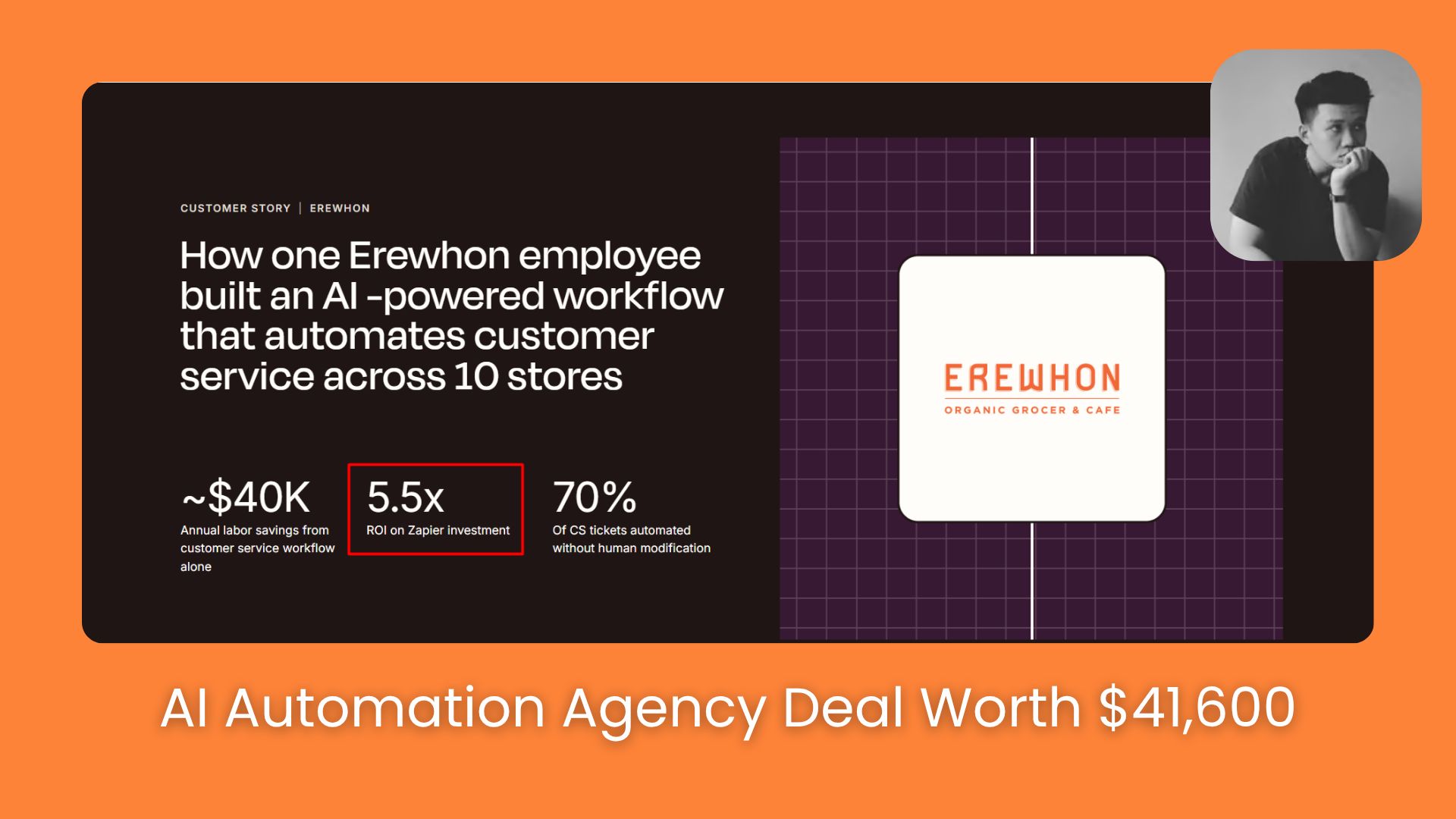
Here’s one of my favourite examples. Erewhon, the luxury grocery chain with 10 stores across LA, used Zapier and ChatGPT to automate their customer service.
One employee built 89 Zaps and automations that process roughly a million tasks per year, including a 39-step AI-powered customer service bot that handles 70% of tickets without any human modification.

→ The results? A 5.5x ROI on their Zapier investment, $40K+ in headcount savings per year from the customer service workflow alone, and 70% of tickets automated without human modification.
→ That $40K saving came from one workflow, built by one employee without a computer science degree. That’s the kind of real-world outcome that justifies value-based pricing.

2. What this means for you
If your automation removes work that already costs a client around $40,000 per year, pricing the project purely by your build hours is leaving serious money on the table.
→ Your time is one input. The business value created is the output that matters.
II. AI Automation Agency Pricing Framework
If you’ve never priced an automation project before, here’s the simple flow to follow:
Step 1: Find the Current Cost
Step 2: Estimate First-Year Value
Step 3: Set the Project Price
Step 1: Find the Current Cost
Before you think about price, figure out what the client’s current process is actually costing them. Look at:
-
Labor costs → how many people, how many hours, at what rate?
-
Manual work → what’s being done by hand that doesn’t need to be?
-
Errors → what do mistakes cost when they happen?
-
Lost revenue → what business is falling through the cracks?
For example, at Palo Alto Networks, a solutions architect built an AI-powered Slack bot that handles demo account provisioning for 3,000 employees → saving the equivalent of one full-time employee, calculated at $150,000 per year.

That wasn’t a huge technical project. It was one person who understood the problem well enough to automate it.
A simpler example: imagine three employees each work 10 hours per week on one process at $30/hour. That’s:
-
3 × 10 × $30 = $900/week
-
$900 × 52 = $46,800/year
Most clients have no idea their process costs that much until you show them the math.
Learn How to Make AI Work For You!
Transform your AI skills with the AI Fire Academy Premium Plan – FREE for 14 days! Gain instant access to 700+ AI workflows, advanced tutorials, exclusive case studies and unbeatable discounts. No risks, cancel anytime.
Start Your Free Trial Today >>
Step 2: Estimate First-Year Value
Once you know the current cost, estimate what changes if the automation works. Include all of these:
|
Value Type |
What to Look For |
|---|---|
|
Labor savings |
Hours freed up × fully-loaded hourly rate |
|
Revenue recovered |
Leads responded to faster, fewer lost sales |
|
Errors reduced |
What do mistakes cost the business? |
|
Extra capacity |
Can the team now handle more volume? |
Actually, recovered revenue can be bigger than labor savings for some businesses.
For example, Corey Ganim built a speed-to-lead agent for a wedding venue rental business. The salesperson was great at closing tours, a 40% close rate, but she was so busy giving tours all day that inbound leads weren’t getting a response until 5–10 hours later. Sometimes the next day. By then, many prospects had already booked elsewhere.
→ Two extra booked tours per month at an $11,000 average deal size adds significant new monthly revenue, and the agent runs for $30/month.
That’s the kind of first-year value calculation that transforms a pricing conversation. The client is paying to stop bleeding revenue.
Step 3: Set the Project Price
Once you have the first-year value estimate, you can use 10% to 20% as a useful starting range.
|
First-Year Value |
10% Price |
15% Price |
20% Price |
|---|---|---|---|
|
$41,600 |
$4,160 |
$6,240 |
$8,320 |
|
$50,000 |
$5,000 |
$7,500 |
$10,000 |
|
$150,000 |
$15,000 |
$22,500 |
$30,000 |
However, don’t treat 10–20% as an industry standard. The AI services market doesn’t have one common benchmark for outcome-based pricing yet.
Use this range as a starting point, then adjust based on scope, complexity, risk, and what the discovery call tells you.
III. Run a Discovery Call That Finds Real Value
I know that it’s really hard to know what project is worth just by looking only at the build time. A solid discovery call is where your pricing actually gets built.
1. Ask questions that give you real numbers
Avoid vague questions. You want specific data points:
-
How long does this process take today?
-
How many people are involved, and what does their time cost?
-
What happens when the process is slow or fails?
-
What is one successful result worth to the business?
-
Why does the client need to solve this now, not in six months?
2. Map how the work actually flows
Businesses rarely keep data in one place. Before you suggest a solution, map out how the work actually moves through the business today.
Where does information come in? Where does it get touched by a human? Where does it go next? What breaks or slows down regularly?
This step helps you find the real bottleneck, and avoid pricing a solution to the wrong problem.
3. Look beyond the time saved
Labor savings are easy to see, but they’re only part of the value. If your automation affects response time, conversion rates, or sales, the business impact can be much larger.
Corey Ganim’s first speed-to-lead agent took him just a few hours to build. He sold it for $1,500. Build time ≠ project value. The value is in what it fixes.
Twitter tweet
IV. Building the Offer the Client Can Get
Once you know what the project is worth, you need to package it in a way that makes the value obvious and the decision easy.
1. Give them 3 options, not 1
Instead of one fixed proposal, offer 3 packages. Each package should change the actual scope, for example:
|
Package |
What’s Included |
|---|---|
|
Starter |
The core automation + the most critical integration |
|
Growth |
Starter + additional workflows, integrations, or reporting |
|
Scale |
Full system with broader automation, advanced features, and ongoing support |
This structure also mirrors how automation work naturally grows in value. As Corey Ganim explains, a single automation typically sells for $1,000–$3,000. Several automations for the same client can become a $5,000–$15,000 project.
Twitter tweet
2. Connect price to value clearly
The simplest way to frame each package to a non-technical client:
You can also make the value concrete by including in the proposal:
-
Hours the team gets back per week/month
-
Errors the automation prevents
-
Revenue the business could recover
-
Additional workload the team can now handle without new hires
At this point, Claude can help you turn your discovery notes into a cleaner offer. Here’s a prompt that turns your notes into 3 clear packages:
You are helping me price and package an AI automation project for a client.

Here is my client information:

Client problem:
[Describe the problem]

Current process:
[Describe how the work happens today]

Current cost:
[Add labor cost, lost revenue, errors, or other costs]

Expected first-year value:
[Add your estimate]

Required automation:
[Describe the automation]

Important integrations:
[List the integrations]

Client budget, if known:
[Add budget or write "Unknown"]

Please create three packages called Starter, Growth, and Scale.

The Starter package should solve the main problem with the smallest useful scope.

The Growth package should add features or integrations that create clear extra value.

The Scale package should cover the wider workflow and include only features that support the client’s business goal.

For each package, include:
- The deliverables
- What business problem it solves
- The expected value
- A suggested price range
- What is outside the scope

You must use only the numbers I provide. You shouldn’t invent revenue, ROI, savings, or client data.

If the client’s budget is below your suggested price, you should reduce the scope instead of discounting the same package.

You should keep the proposal simple enough for a non-technical client to understand.
3. What to do when the budget is too low
If the client says it’s too expensive, don’t discount the same package. Instead, reduce the scope.
A $10,000 project can become a $5,000 project if you remove 2 integrations and defer advanced reporting to Phase 2.
The lower price now matches a genuinely smaller scope, and you’ve set up a natural conversation about Phase 2 once Phase 1 delivers results.
V. Protect Your AI Automation Agency Margin
Sad to say, but a well-priced project can still lose margin if scope creep takes over or post-launch support becomes a second full project. Here’s how to protect yourself from the start.
1. Control scope with a Version 2 backlog
When a client asks for a new feature mid-project, don’t say yes or no right away. Say:
"Great idea, I'll add that to the Version 2 backlog so we can scope and price it properly after we deliver this phase."This keeps your current project focused and gives the client something to look forward to. If the original project includes lead capture, CRM updates, and email follow-up, and the client asks for WhatsApp automation halfway through, that goes in the backlog.
2. Set milestones with clear payment triggers
Each milestone should describe a result the client can test, not just a deliverable you hand over. And each milestone should connect to a payment.
Here’s an example of a well-defined milestone:
-
✅ Client submits a test lead through the form
-
✅ CRM receives the lead details correctly
-
✅ Salesperson gets a Slack alert within 60 seconds
-
✅ Client confirms the workflow matches the agreed spec
-
→ Next payment becomes due
3. Define maintenance before you go live
Before the automation launches, agree in writing on what maintenance covers and what it doesn’t.
|
Covered by maintenance |
Requires new scope |
|---|---|
|
Fixing broken integrations |
Adding new workflows or channels |
|
Handling API changes |
New features or reporting |
|
Small adjustments to keep current workflow working |
Rebuilding or significantly changing existing logic |
For example, Marty also explains that his OpenClaw setup has faced gateway crashes, config loss after auto-updates, and routing issues that still need manual fixes.
Twitter tweet
This distinction matters more than you think. Real production systems break in unexpected ways after launch. Having a clear maintenance agreement means you can fix these things without it turning into a free consulting session.
Conclusion: Putting It All Together
If you run an AI Automation Agency, you can use a simple process:
-
Find the current cost → what is the manual process actually costing them in time, errors, and lost revenue?
-
Estimate first-year value → what changes if you fix it? Labor savings, recovered revenue, extra capacity?
-
Build packages → three tiers with genuinely different scope, not just different prices
-
Set clear milestones → testable results tied to payment points
-
Define maintenance upfront so support doesn’t eat your margin after launch
You’ll still need to adjust every project based on complexity, risk, and the client’s specific situation. But when your client understands where the value comes from, your price becomes very easy to explain, and very easy to say yes to.
If you are interested in other topics and how AI is transforming different aspects of our lives or even in making money using AI with more detailed, step-by-step guidance, you can find our other articles here:
-
FREE Claude Prompt That AUTO Turns Any Idea Into a VOX-Style Video (Full Guide)
-
How to Use Gemini + NotebookLM to Keep Your AI Accurate Every Time (For Free)
-
Claude Opus 5 vs GPT-5.6 Sol Create 3 INCREDIBLE Projects (3 Insane Challenges)*
-
Qwen 3.8 Max Is Here. I Tested If It Can Beat Today’s BEST Open Models*
-
3 AI Video Generators That Are ACTUALLY FREE with Daily Credits (Almost Unlimited)*
*indicates a premium content, if any
Leave a Reply