
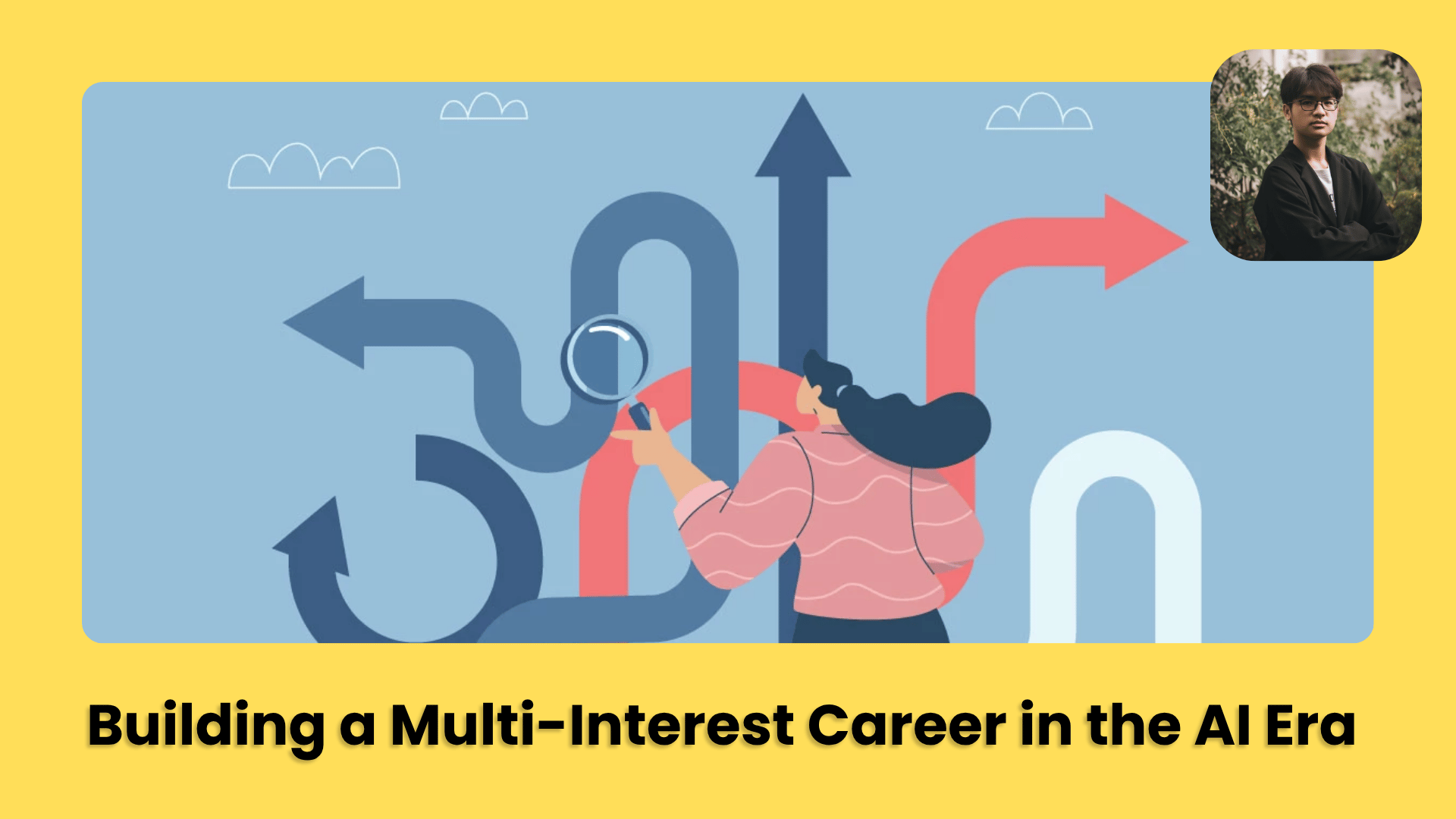
If you’ve ever felt behind because your interests don’t fit one box, this guide will help you turn that into a strength instead of a weakness.. How To Make Money With Ai, Ai Fire 101, Ai Reports, Ai Workflows.
TL;DR BOX
The classic career advice of “pick one lane and go deep” is breaking down in an AI-driven economy. As automation replaces entry-level and junior-level roles, narrow specialists are losing the very ladder they were told to climb. Meanwhile, people with multiple interests, the same people often labeled “unfocused,” may now have a real structural advantage: the ability to connect ideas across domains in ways AI cannot easily replicate.
This guide introduces two practical frameworks. The LINK Test helps you identify which of your interests genuinely reinforce each other (and which ones are just competing for calendar space). The Sorting Hat Framework helps you assign each interest a clear job: stability, optionality, restoration or strength. Together, they help you turn scattered curiosity into a career strategy that actually compounds over time.
Key Points:
Fact: A Michigan State University study of 773 Nobel Prize winners found that elite scientists were significantly more likely than average to practice artistic side activities like fiction writing, music, acting or even magic performance.
Mistake: Treating every interest as equally important right now. Without a framework, curiosity becomes chaos. Use the Sorting Hat (Section VII) to assign each interest a specific role before investing more time.
Action: Pick two of your strongest interests today and run the LINK Test (Section V). If they score 3 or higher, you have a compounding pair worth stacking immediately.
Table of Contents
I. Introduction
For a long time, people with many interests were told to choose one path and stay there. If you enjoyed design, coding, writing and psychology at the same time, the common response was simple: pick one.
That advice made sense when careers followed a predictable ladder. You started at the bottom, built experience step by step and moved upward.
But the structure of work is already changing. AI is beginning to automate many entry-level tasks that once helped people develop expertise.
Research from McKinsey suggests that up to 30% of current work activities could be automated as early as 2030. And one report from the World Economic Forum has also estimated that 85M jobs could be displaced by automation by 2025, even as 97M new roles emerge.

Source: McKinsey Global Institute & World Economic Forum.
In this guide, I’ll show you why broader skill sets are getting more valuable, how to tell the difference between useful breadth and random distraction and how to build a career that works more like a network than a single ladder. This guide is useful if:
-
You have many interests and don’t know how to combine them.
-
You worry automation may replace entry-level roles.
-
You want to turn curiosity into a structured career advantage.
-
You want long-term career stability, not short-term trends.
-
Bonus: LINK Test + Sorting Hat framework to organize skill stack.
You’ve reached the locked part! Subscribe to read the rest.
Get access to this post and other subscriber-only content.
Upgrade Translation missing: en.app.shared.conjuction.or Sign In
A subscription gets you
- Instant access to 700+ AI workflows ($5,800+ Value)
- Advanced AI tutorials: Master prompt engineering, RAG, model fine-tuning, Hugging Face, and open-source LLMs, etc ($2,997+ Value)
- Daily AI Tutorials: Unlock new AI tools, money-making strategies, and industry (ecommerce, marketing, coding, teaching, and more) transformations (with videos!) ($3,650+ Value)
- AI Case studies: Discover how companies use AI for internal success and innovative products ($1,997+ Value)
- $300,000+ Savings/Discounts: Save big on top AI tools and exclusive startup discounts
Leave a Reply