
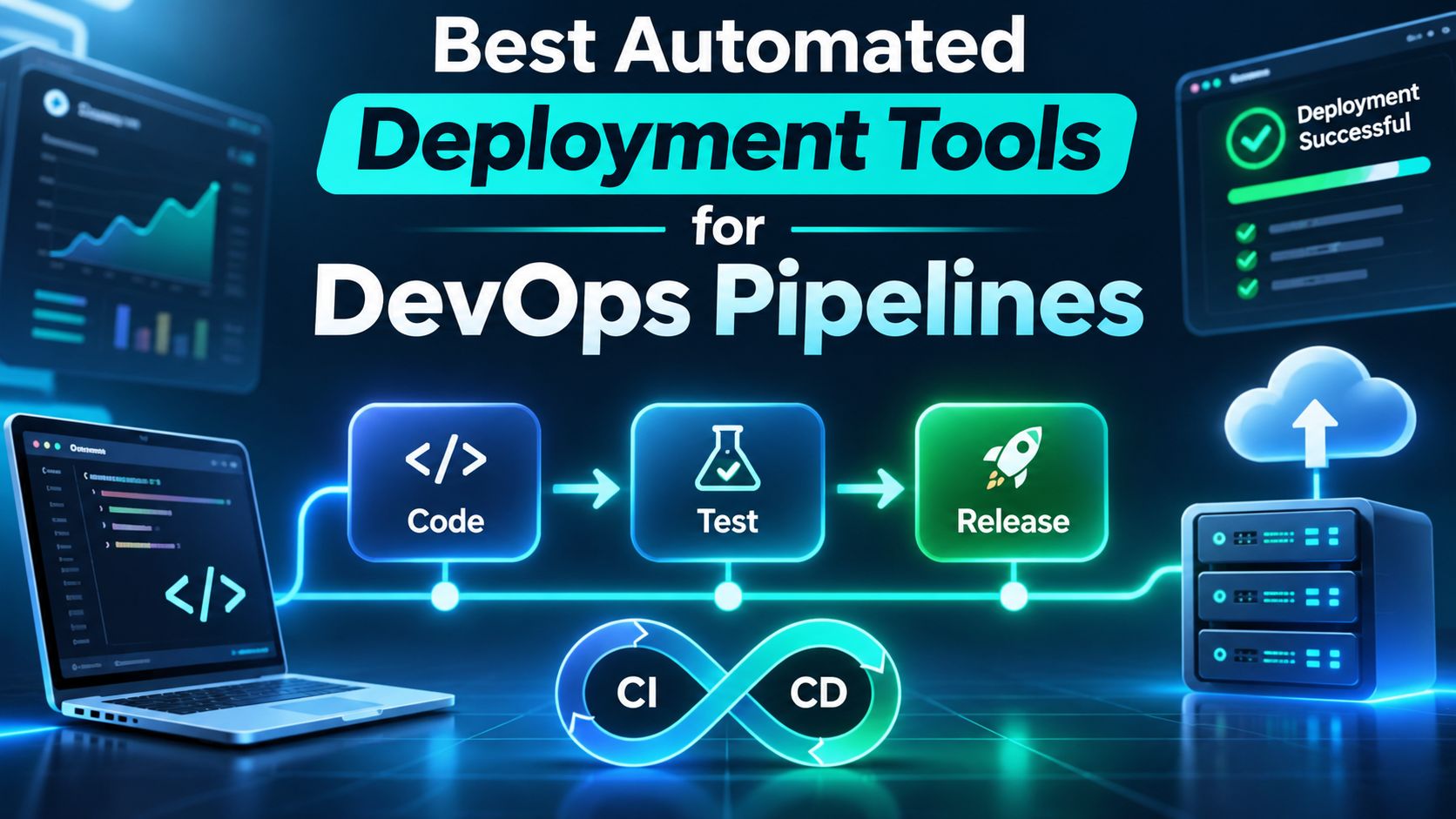
Explore 5 automated deployment tools for DevOps teams. Compare key features, benefits, and testing capabilities to improve CI/CD workflows and release quality.. .
Table of Contents
Getting software out the door quickly without wrecking production is something every DevOps team wrestles with. The deployment tool a team picks can genuinely separate those who ship daily from those who still break into a cold sweat before Friday releases. Below are five tools worth considering if your team is weighing its options right now.
Why Deployment Automation Matters in Modern DevOps
Pipelines that incorporate automated deployment tools for DevOps teams can release code on a consistent, predictable schedule rather than depending on manual handoffs that introduce errors at every step. Manual deployment is slow, inconsistency compounds over time, and the cognitive load on engineers grows with each environment. Automation removes that variability.
The best automated deployment tools for DevOps pipelines validate code, roll back on failure, and give teams visibility into every stage of the release.
1. Functionize

Functionize is a native testing and deployment platform founded in 2014 and based in Walnut Creek, California. Its technology draws on eight years of enterprise training and more than 30,000 data points per page to hit 99.97% element recognition accuracy, which cuts flaky tests and maintenance overhead by 80%. GE Healthcare ran the platform and brought 40 hours of testing down to just 4 hours, a 90% drop in labor. Non-technical teams can build and deploy tests up to 90% faster than old-school scripting methods, and self-healing agents adjust on their own when an application changes. Functionize’s guide to automated deployment tools for DevOps teams breaks down how CI/CD platforms connect with testing frameworks to cut out manual handoffs between development and operations phases.
Key features:
-
Agents that autonomously plan, adapt, and execute tests across environments
-
Self-healing element recognition at 99.97% accuracy
-
No-code test creation for non-technical team members
-
Real-time adaptation to application UI changes
Pros:
-
Dramatically reduced test maintenance compared to script-based tools
-
Proven enterprise results across Fortune 500 clients
-
Named a Strong Performer in Forrester’s Q4 2025 Wave Report on Autonomous Testing Platforms
-
Backed by $41 million Series B funding, signaling strong ongoing development
2. Cypress

Cypress is a front-end testing platform that launched in 2015 out of Atlanta, Georgia. It’s built for developers and QA engineers who want to write and debug tests right inside the browser, trimming the feedback loop that makes traditional testing workflows drag. The platform has logged over 5 billion tests across more than 3,700 customers in 78 countries, with Adobe and DHL among its clients.
Key features:
-
In-browser test writing, running, and debugging
-
Natural language test generation
-
Cypress Cloud for smart orchestration, visual reviews, and analytics
-
Flake-resistance features and self-healing capabilities
Pros:
-
Strong developer experience with interactive, step-by-step test inspection
-
Free open-source tier makes it accessible for small teams
-
Converts each test into quantifiable quality insights over time
Cons:
-
Specific Cypress Cloud pricing isn’t publicly listed, requiring direct contact
-
At 94 employees, enterprise-level support resources are smaller than some competitors
3. ACCELQ

ACCELQ is a continuous testing platform founded in 2014 and headquartered in Dallas, Texas, with offices also in India, Canada, and Australia. It goes after Fortune 500 enterprises in financial services, healthcare, and travel. One large insurance client cut defect leakage by 87% and shrank regression cycles by 80% through ACCELQ’s business-driven test automation. No IDE is needed; the platform runs entirely in the browser.
Key features:
-
Codeless natural language functional and API automation
-
Unified coverage for Web UI, API, Mobile, and Desktop
-
3X faster test design and maintenance vs. traditional approaches
-
Browser-based platform with no local installation needed
Pros:
-
G2 Leader in Spring 2024 Automation Testing Category with a 4.8/5 rating
-
Customers typically save over 70% on change and maintenance costs
-
Forrester named it a leader in Continuous Functional Test Automation Suites (Q2 2020)
4. Testsigma

Testsigma is an agentic test automation platform founded in 2019 and based in San Francisco. Its standout feature is Atto, an AI coworker that deploys a team of agents to autonomously plan, design, run, and maintain tests. Testers write steps in plain English. The platform takes it from there, and clients include Nestlé, Samsung, Cisco, KFC, and DHL.
Key features:
-
Atto AI coworker with autonomous test planning and execution
-
Plain-English test step authoring
-
Coverage for web, mobile, desktop, API, Salesforce, and SAP
-
30+ native integrations plus visual and accessibility testing
Pros:
-
AI self-healing automatically fixes broken locators when the UI changes
-
Recognized in Gartner Magic Quadrant for Software Test Automation
-
Holds a 4.5/5 rating on G2 (Leader quadrant, Fall 2025)
5. Selenium Testing

Selenium is the open-source browser automation project that started it all. Jason Huggins built its predecessor at ThoughtWorks in 2004, and the later merger with WebDriver laid the foundation that most browser-testing tools still borrow from today. It’s governed by the Software Freedom Conservancy and stays free under the Apache License 2.0 with no commercial model attached.
Key features:
-
Selenium WebDriver for cross-browser instruction-based automation
-
Selenium IDE for record-and-playback test creation
-
Selenium Grid for distributed testing across multiple machines and environments
-
Broad language support across all major programming ecosystems
Pros:
-
Completely free with no licensing costs
-
Enormous community and years of documentation
-
Interoperable with virtually every CI/CD pipeline and test framework
How to Pick the Right Tool for Your Pipeline
Start with team composition. If developers own the pipeline end-to-end, a code-first tool like Selenium or Cypress fits naturally. If QA analysts or product teams run tests, a codeless platform like ACCELQ or Testsigma removes the scripting barrier. Budget matters too: Selenium costs nothing upfront but carries a hidden labor cost in maintenance. Paid platforms trade subscription fees for time savings.
And consider scale. Small teams often start with an open-source foundation and layer in a managed platform once flaky tests and maintenance overhead become the bigger bottleneck. Enterprise teams with complex multi-environment pipelines typically need AI self-healing and smart orchestration from day one.
The best automated deployment tools for DevOps pipelines aren’t the most feature-rich, they’re the ones your team will actually use consistently.
Bottom Line
Deployment automation has matured considerably. Teams no longer have to choose between speed and stability when picking tools for their DevOps pipelines. Whether the priority is codeless simplicity, open-source flexibility, or AI-driven self-healing, the tools on this list cover that range. Matching the right platform to team skill level and release cadence is what separates a productive pipeline from one that creates more work than it saves.
Leave a Reply