
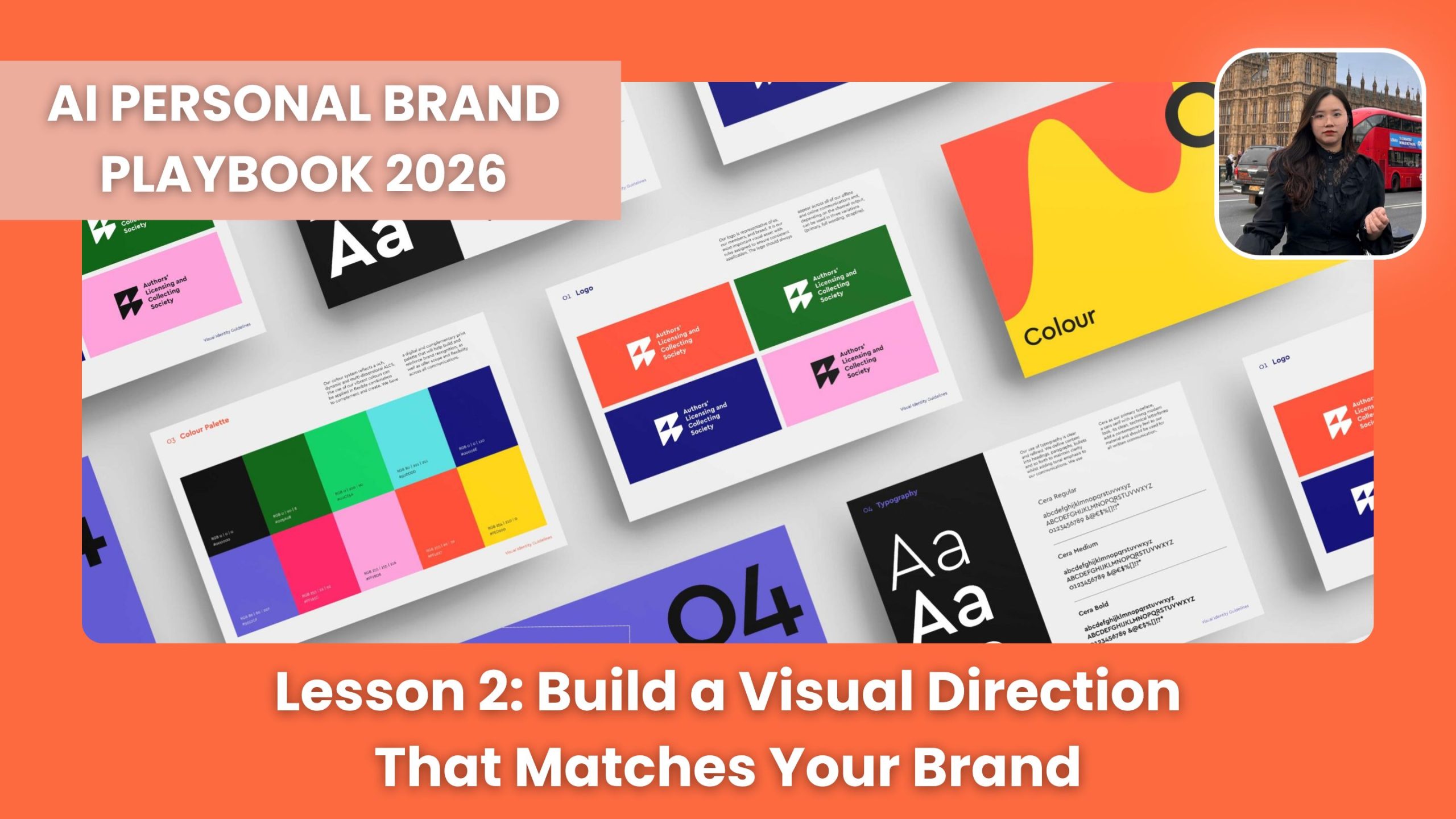
Master the workflow of using AI to build moodboards, analyze creator benchmarks, and test layouts that maximize recognition on mobile feeds.. Ai Tools, 🔥 Ai Fire Academy, Ai Courses.
TL;DR
Your personal brand becomes easier to recognize when the visuals consistently support your positioning, audience, and content style. Before creating logos or final assets, you first need a clear visual direction system.
This lesson focuses on translating brand strategy into visual decisions using creator references, moodboards, AI-assisted workflows, and real platform testing. You will explore multiple visual directions, study how recognizable creators structure their branding, and refine your own typography, layouts, spacing, image treatment, and overall visual energy.
You will also test your direction across LinkedIn, X, YouTube, newsletters, and mobile previews to see how the branding behaves in real creator environments.
Key points
Fact: HubSpot research shows visual consistency improves brand recognition across digital platforms.
Mistake: copying random aesthetics that do not match your creator positioning.
Takeaway: testing layouts on mobile usually exposes weak visual decisions quickly.
Critical insight
A visual style that looks impressive in isolation can still fail once repeated across weeks of real creator content.
Table of Contents
Introduction
Throughout Lesson 1, you built the strategic foundation behind your personal brand. You clarified your audience, positioning, values, messaging, and the type of creator presence you want people to remember. Now it’s time to turn that strategy into something people can recognize visually.
A lot of creators and freelancers struggle at this stage. Their ideas are strong, but the brand still feels unfinished online. The profile photo looks random, the visuals feel inconsistent, and nothing creates a strong first impression yet. Even valuable content becomes harder to remember when the presentation feels disconnected.
That first impression matters more than most beginners realize. Research from Stanford University found that visual design strongly influences perceived credibility online, often before people fully engage with the content itself. In crowded creator ecosystems like LinkedIn, X, YouTube, and newsletters, people usually judge the visuals before reading a single word. Your avatar, typography, layouts, colors, and overall presentation immediately affect how professional, trustworthy, modern, or recognizable the brand feels.
AI tools have also made visual creation dramatically faster. Anyone can now generate logos, layouts, and graphics in minutes using tools like Canva or Looka. The problem is many personal brands now start looking identical because they rely too heavily on generic AI-generated aesthetics instead of building a recognizable visual direction.
By the end of this lesson, your brand should stop feeling like disconnected ideas and start feeling like a recognizable personal brand people can remember much more easily online.
I. Why Visual Direction Matters More in Personal Branding
A lot of beginners treat visual branding like decoration. They focus on making things “look cool” instead of thinking about what people actually remember.
But personal branding works differently. Most people do not remember creators because of one perfect logo or one beautiful design. Recognition usually comes from repetition and familiarity over time. The audience starts associating certain visual patterns with you:
-
the way your posts are structured
-
the typography you repeatedly use
-
your thumbnails
-
your profile image
-
the overall feeling your content creates in-feed
That consistency slowly builds trust because people begin recognizing your creator presence before they even read the content itself.
This matters even more in AI-related spaces where content moves extremely fast and many creators talk about the same tools, updates, and tutorials. According to Nielsen Norman Group research on visual hierarchy and scanning behavior, people scan digital content very quickly and rely heavily on visual structure to process information. Strong visual direction helps your content become easier to recognize in crowded feeds where attention is limited.
AI tools have also changed personal branding workflows completely. Creators can now generate visuals, layouts, and branding ideas much faster than before. But that speed creates a new challenge: many AI personal brands now start looking identical because they rely too heavily on generic AI-generated aesthetics instead of building a recognizable creator identity.
The strongest personal brands usually use AI to:
-
explore ideas faster
-
test visual directions quickly
-
refine consistency over time
not to replace personality, positioning, or creator identity.
The goal here is not building the flashiest personal brand possible. Most memorable creator brands are visually simple. What makes them recognizable is that the visuals consistently reinforce the personality and positioning behind the content.
Your Task
Before moving forward, spend a few minutes thinking about how you want people to perceive your personal brand online.
You might want to write down:
You’ve reached the locked part! Subscribe to read the rest.
Get access to this post and other subscriber-only content.
Upgrade Translation missing: en.app.shared.conjuction.or Sign In
A subscription gets you
- Instant access to 700+ AI workflows ($5,800+ Value)
- Advanced AI tutorials: Master prompt engineering, RAG, model fine-tuning, Hugging Face, and open-source LLMs, etc ($2,997+ Value)
- Daily AI Tutorials: Unlock new AI tools, money-making strategies, and industry (ecommerce, marketing, coding, teaching, and more) transformations (with videos!) ($3,650+ Value)
- AI Case studies: Discover how companies use AI for internal success and innovative products ($1,997+ Value)
- $300,000+ Savings/Discounts: Save big on top AI tools and exclusive startup discounts
Leave a Reply