AI split the job market into 2 tracks. I’ll show you where the job market is moving, what companies actually value now, and how to stay ahead.. Ai Tools, 🔥 Ai Fire Academy, Ai Automations.
TL;DR
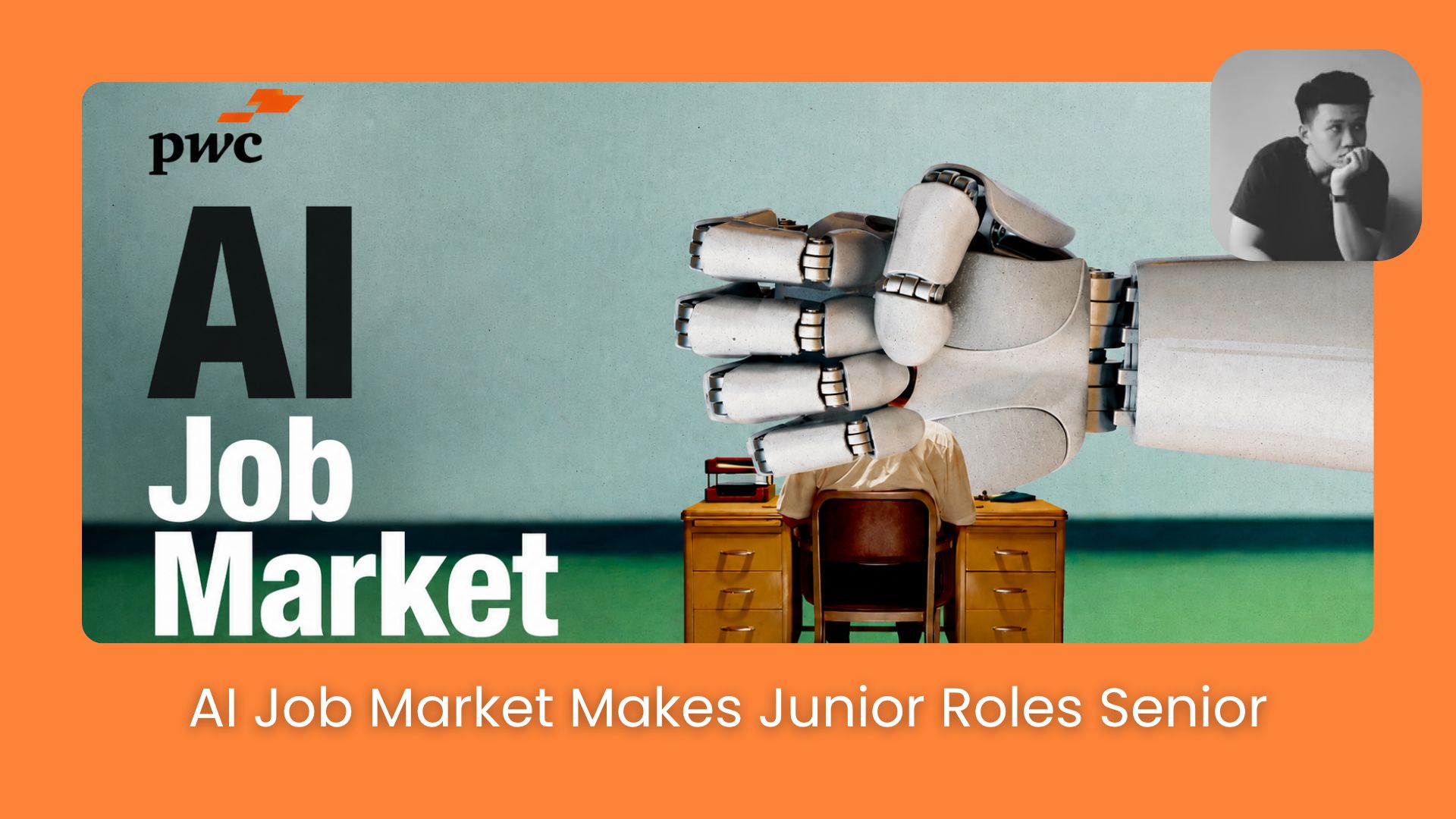
AI is changing entry-level work by raising the skills companies expect from new workers. In the AI Job Market, junior roles exposed to AI increasingly require judgement, leadership, communication, and ownership.
PwC found that AI-exposed entry-level jobs are becoming more “seniorised” as routine work gets automated. Workers may face harder tasks earlier because AI can already handle many basic tasks.
The stronger path is to use AI inside real workflows while building skills that still depend on human judgement. You should focus on roles where AI helps you take on more responsibility.
Key points
AI-exposed entry-level roles are seven times more likely to require traditionally senior-level skills.
“Seniorised” entry-level roles grew 35% since 2019, while other entry-level roles fell 10%.
Knowing ChatGPT or Claude is becoming basic. Employers increasingly value judgement, communication, decision-making, and ownership.
Table of Contents
Introduction
So, AI is about to take all your jobs, right?
You’ve probably heard that one before. Every time a new model comes out, people start saying the AI Job Market will soon become a place where humans just sit back and watch AI do everything.
But PwC’s latest data shows a slightly more uncomfortable story. AI is also raising the hiring bar, especially for people who are just entering the workforce.
Entry-level roles with high AI exposure now increasingly require skills. AI job market is starting to split into 2 very different paths.
I’ll show you what PwC found, why this split is happening, and which side of the AI Job Market you’re more likely to end up on.
I. AI Job Market is Splitting into 2 Tracks
PwC calls this a “two-track labour market,” and that description fits exactly what’s happening right now.
Key points
-
The AI job market is splitting into two paths.
-
AI-exposed roles now expect stronger human skills earlier.
-
Some “entry-level” jobs already look more like mid-level roles.

If you’re looking for an entry-level job, you’re no longer entering a market where every role is moving in the same direction.
Some jobs are raising their requirements fast because AI can already handle many basic tasks. At the same time, demand for other entry-level roles is quietly falling.
|
Job Type |
What’s Happening |
What Employers Now Expect |
|---|---|---|
|
AI-exposed “professionalised” roles |
Demand can still grow, but the hiring bar is rising |
Judgement, leadership, ownership, and problem-solving, earlier than before |
|
AI-exposed “democratised” roles |
AI is making the job easier for non-experts, but growth is slower |
Basic AI fluency, less human expertise required |
|
Other entry-level roles |
Demand is falling in many areas |
Companies may remove simple tasks or absorb them into other roles |
-
Professionalised roles = AI automates the routine work, so the human does higher-value things. Example: a radiologist still reads scans, but AI handles the basic filtering. These roles are growing at twice the rate and seeing 42% faster salary growth.
-
Democratised roles = AI makes the expert tasks easier for anyone to do. Example: an IT service manager whose deep technical knowledge is less needed because AI can guide non-experts through the same steps. Growth here is slower.
So before you ask “will AI take my job?”, also ask: “Is this job becoming more professionalised or more democratised?”
→ That question tells you a lot more about your future than the job title does.
II. “Entry-Level” Doesn’t Mean What It Used To
This is where the AI job market starts to feel a little strange, and honestly, a little unfair.
You can apply for a role called “entry-level” and the company may still expect you to think like someone with several years of experience. The title hasn’t changed. The job description quietly has.
PwC found that AI-exposed entry-level roles are 7x more likely to require skills traditionally linked to senior workers. In the most AI-exposed occupations, 52% of new skills appearing in entry-level job postings were skills traditionally associated with experienced workers. In the least AI-exposed occupations, that figure was just 7%.
Here’s what those skills actually look like in a real job:
|
Skill |
What It Means Day-to-Day |
|---|---|
|
Judgement |
Knowing when an AI output makes sense and when you need to double-check it |
|
Leadership |
Making decisions and taking responsibility earlier, not waiting to be told |
|
Creativity |
Finding a new direction when the usual process isn’t enough |
|
Human interaction |
Handling situations that need empathy, persuasion, or reading a room |
|
Stakeholder management |
Communicating upward, sideways, and to clients, not just completing tasks |
The reason this is happening is actually simple. When ChatGPT, Claude, or other AI systems can already handle the repetitive, well-defined tasks, the work left for junior employees gets harder, faster.
As Dan Priest, PwC’s U.S. Chief AI Officer, put it. The job description is moving first. The paycheck may take longer to catch up.
Twitter tweet
Junior workers may actually be spared years of drudgery on basic tasks, but the trade-off is that they need to step up to complex decision-making much sooner.
Learn How to Make AI Work For You!
Transform your AI skills with the AI Fire Academy Premium Plan – FREE for 14 days! Gain instant access to 700+ AI workflows, advanced tutorials, exclusive case studies and unbeatable discounts. No risks, cancel anytime.
Start Your Free Trial Today >>
III. Where the AI Job Market is Heading in 2026-2027
If you only take one stat away from this whole article, I’d say it’s this one.
Seniorised entry-level roles have grown 35% since 2019, while other entry-level roles shrank 10% over the same period.
→ That’s a 45-point gap, and it’s been building for years, not just since the latest AI wave. It shows a clear structural shift.
And there’s more context that makes this feel even more real:
-
A Harvard working paper analysing 62 million workers found junior hiring fell nearly 8% within six quarters at companies that adopted AI through a quiet freeze on new positions.
-
Recent graduate unemployment reached 5.7% in Q4 2025, above the national rate, with 42.5% of recent graduates in underemployment in roles that don’t match their training or qualification level.
-
Workers with AI skills now earn about 62% more than those without, up from 57% a year ago.

So the picture is this: entry-level positions haven’t vanished, but the job description has been promoted up the skills ladder, without telling the people trying to get their foot in the door.
💡 Entry-level titles may stay the same even when the real work becomes more senior. You can’t rely on the label. You need to read the job description and ask what it’s actually asking you to do.
IV. What the AI Job Market Now Rewards
Job postings requiring AI skills doubled between 2024 and 2025, which means AI fluency is fast becoming something everyone is expected to have. The bigger difference is what you do after AI has done the first part of the work.
Employers are increasingly looking for:
|
Skill |
What They Actually Want to See |
|---|---|
|
Judgement |
You know which AI results to trust and which ones to question |
|
Decision-making |
You can choose the right direction when AI gives you several options |
|
Communication |
You can explain ideas clearly to teams, clients, or managers |
|
Ownership |
You take responsibility for the final result, not just hand over what AI generated |
These used to matter when you were trying to move up. Now, some employers already expect them when you apply for your first role.
That’s why you should read every job description as a signal about which track it’s on and how much it actually expects from day one.
Use This Prompt to Read Any Job Description Like a Career Analyst
Before you apply for a role, run this through ChatGPT to see what you’re actually walking into:
I want you to act as a career analyst focused on how AI is changing entry-level work.

I’ll give you:
1. A job description
2. My current skills and experience
3. The AI tools I already use

Analyze the role in detail and separate the work into these categories:

- Tasks that AI can already handle or strongly assist with
- Tasks that still require human judgement
- Tasks that require decision-making or ownership
- Tasks that depend on communication, collaboration, or understanding people
- Requirements that look “entry-level” on paper but actually need mid-level or senior-level skills

Then compare the job requirements with my current skills.

For each skill gap, explain:
- Why this skill matters in an AI-heavy workplace
- How important it is from 1 to 10
- What I can do to improve it
- What real project, work sample, or portfolio evidence could prove I have this skill

Finally, create a priority plan showing:
- Skills I should improve first
- Skills AI can help me with
- Skills I shouldn’t depend on AI for
- What would make me more valuable than someone who only knows how to use ChatGPT or Claude

Be specific to the job description I provide. Don’t give generic career advice.

Job description:
[PASTE JOB DESCRIPTION]

My current skills and experience:
[PASTE HERE]

AI tools I currently use:
[PASTE HERE]
V. How to Stay on the Growing Side of This
If you want to stay on the professionalised track, you need to know clearly which parts of your job AI can support and which parts still depend on you. You can break your role down like this:
|
Part of the Job |
What AI Can Do |
What You Still Need to Do |
|---|---|---|
|
Research & summaries |
Find key points, summarise, organise data faster |
Check sources, decide what’s actually useful, choose what to act on |
|
Drafting & content |
Create first drafts, outlines, several versions quickly |
Pick the right angle, fix the tone, make sure it fits the real goal |
|
Basic analysis |
Find patterns, compare data, suggest insights |
Understand the context and decide which insight is worth acting on |
|
Decision-making |
Give you several possible options |
Choose the final direction and own the outcome |
|
Communication |
Help prepare or clarify ideas |
Read the room, handle feedback, work well with people |
|
Ownership |
Support steps in a workflow |
Understand the end goal and make sure the work lands well |
The key is to use AI inside real workflows to have actually used it to complete real work. If you’ve only written prompts in demos, that edge is thin.
You should also actively look for roles where AI removes routine work and gives you more responsibility.
If you’re already working, this one helps you see where you stand and what to build next:
I want you to analyse my current role and show me how I can move toward the stronger side of the AI Job Market.

I’ll give you:
1. My current job title
2. My main weekly tasks
3. The AI tools I already use
4. The type of role I want next

Analyse my work task by task.

For each task, tell me:
- How much of it AI can already automate or speed up
- Which part still needs human judgement
- Which part requires communication, problem-solving, or ownership
- Whether this task is likely to become more or less valuable over the next few years
- How I can redesign the task so AI handles more routine work while I take on higher-value responsibility

Then create a table with these columns:
- Current task
- AI can handle
- Human value still needed
- Risk level from automation
- Skill I should build next
- One real project I can do to prove that skill

After that, identify the three biggest weaknesses in my current skill set.

For each weakness, explain:
- Why it could hurt me in an AI-heavy job market
- What I should practise
- How I can use AI without becoming dependent on it
- What proof I can add to my portfolio or CV

Finally, give me a 30-day action plan that helps me move from doing routine work to taking more judgement, decision-making, communication, and ownership.

Keep the advice specific to my role. Don’t give generic career tips.

My current job title:
[PASTE HERE]

My main weekly tasks:
[PASTE HERE]

AI tools I already use:
[PASTE HERE]

The role I want next:
[PASTE HERE]
Conclusion
The AI job market is changing fast, but the biggest shift is that companies are starting to expect harder work earlier, with less hand-holding.
Sad to say, but just knowing how to use ChatGPT or Claude is already becoming a baseline. The real advantage now comes from what you do after AI has handled the first draft, the research, or the basic analysis. That’s where judgement, communication, ownership, and decision-making kick in, and those are the skills that still depend on you.
The good news? You can still start in an entry-level role. But going in, you should know: the title might say junior, while the actual job expects something closer to mid-level.
If you are interested in other topics and how AI is transforming different aspects of our lives or even in making money using AI with more detailed, step-by-step guidance, you can find our other articles here:
-
Grok Bot Just Killed 1,000 Startups? An Insanely Easy AI Agent Anyone Can Use 24/7
-
The AI Agent Pricing Framework That Turns $5,500 Projects Into $41,600 Value (Real Case)
-
Multi Agent System: Use Graph Engineering to Make Claude & Codex 10x Better*
-
7 Jobs Claude Code Does Better than ChatGPT at Work (And None of Them Are Coding)*
-
This NEW Claude Prompting Technique Is a INSANELY Game Changer (Full Guide)*
*indicates a premium content, if any
Leave a Reply