
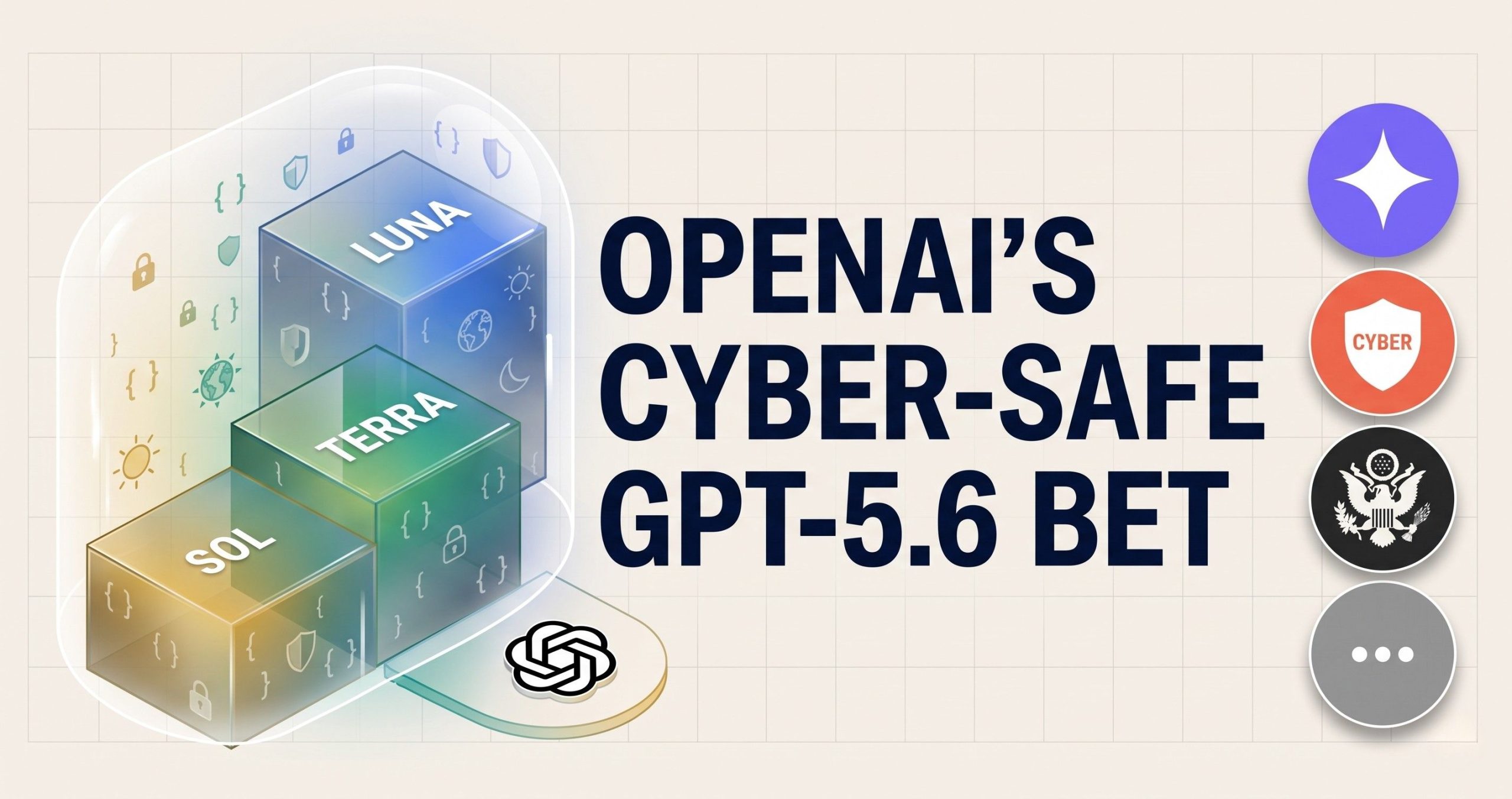
🔐 GPT-5.6 Sol Gets Gated. .
Free AFIRE Guide | AI Academy | Advertise | AI Mastery A-Z

Plus: 5 Best AI Video Generator Apps on Your Phone (2026 Updated List)
GPT-5.6 Sol is OpenAI’s next power play: stronger coding, deeper cyber skills, and a rollout so sensitive the U.S. government wants trusted partners to see it first.
What’s on FIRE 🔥
IN PARTNERSHIP WITH WILLO

Describe your business in one sentence. Online store? Service business? SaaS? Knowledge hub? Directory? Just describe what you want to build.
Willo creates the foundation, tools, and growth assets so you can launch faster without hiring developers, designers, or marketers.

AI INSIGHTS
🌞 OpenAI Previews GPT-5.6 Sol With Stronger Reasoning And Cyber Safeguards

OpenAI just previewed GPT-5.6, its next model family. It comes in three tiers:
-
Sol: strongest model for hard tasks
-
Terra: balanced model for daily work
-
Luna: fast and cheaper model
The headline: GPT-5.6 Sol is OpenAI’s strongest model yet, with big gains in coding, biology, and cybersecurity.
For coding, GPT-5.6 Sol Ultra scored 91.9% on Terminal-Bench 2.1, beating Claude Mythos 5, Claude Fable 5, GPT-5.5, and Gemini 3.1 Pro Preview.
OpenAI also added:
-
Max reasoning effort: gives Sol more time to think
-
Ultra mode: uses subagents to handle complex tasks faster
The sensitive part is cybersecurity. GPT-5.6 Sol can help find and fix vulnerabilities, but OpenAI says it does not cross its Cyber Critical threshold. It found bugs in Chromium and Firefox tests, but did not complete a full autonomous exploit chain.
That’s why the rollout is slower. At the U.S. government’s request, OpenAI is starting with a small group of trusted partners before a wider release in the coming weeks.
For builders, pricing starts at:
-
Sol: $5 input / $30 output per 1M tokens
-
Terra: $2.50 / $15
-
Luna: $1 / $6
One more big detail: GPT-5.6 Sol is coming to Cerebras in July, with speeds up to 750 tokens per second for select customers. This is OpenAI trying to push model power forward, while proving it can keep the risky parts under control.
PRESENTED BY BELAY
When Did Your Business Start Running You?

What started as ownership turned into obligation.
Now you’re in every meeting, decision, and channel… not because you want to be, but because things stall without you.
It’s not a capacity issue. It’s a structure issue.
The Freedom Framework shows you how to rebuild work flows, so you can step back without things breaking down.
BELAY U.S.-based Assistants help make that real by bringing ownership to execution, so your business doesn’t rely on you to function.
AI SOURCES FROM AI FIRE
1. Build an Interactive Award-Winning Portfolio Website Without Coding – Real Demo Breakdown. Learn how Claude + Base44 can turn your work into interactive case studies, clear navigation, client proof, and a contact system that helps visitors reach out faster.
2. 5 Best AI Video Generator Apps on Your Phone 2026 Updated List. We tested Google Flow, Runway, Kling AI, ImagineArt, and Hailuo AI on mobile so you can pick the right app for quality, speed, motion control, or low-cost video creation.
3. Vague Claude Answers? These 5 Prompts Will Change That Instantly. A simple prompt system for getting clearer Claude outputs. Learn how to make Claude ask better questions, review drafts from different angles, build long documents in stages, break down projects, and save context once.
TODAY IN AI
AI HIGHLIGHTS
🌍 Qwen just released Qwen-AgentWorld, a 35B open-weight world model that simulates 7 agent environments, from terminal and web to Android. It even beats GPT-5.4 and Claude Opus 4.8 on AgentWorldBench.
🧑💻 xAI just added Grok to T3code, the open-source desktop app for managing AI coding agents. If you already pay for SuperGrok or X Premium+, you can use Grok as a coding agent with no API key.
🔐 Anthropic gave Claude Tag its own agent identity. Claude can now act as itself inside team channels, with admin-controlled access to Slack, GitHub, docs, warehouses, and other tools.
📈 AI Berkshire is going viral on GitHub. It claims a 69.29% return in 2024, beating the S&P 500 by 46 points, using Claude Code and Codex for value-investing research.
🎨 Adobe is buying Topaz Labs, a 20+ year-old AI photo & video company. Its tools will join Firefly & Creative Cloud, helping users upscale, denoise, restore content faster.
💰 Big AI Investment: Amazon will invest another $13B in India’s AI and cloud infrastructure by 2030, expanding AWS data centers in Mumbai and Hyderabad. Its total India commitment now reaches $48B.
HOT PAPERS OF THE WEEK
1/ Agent memory is becoming a full data system
Are We Ready For An Agent-Native Memory System? from Shanghai Jiao Tong University, Tsinghua University, and MemTensor studies how LLM agent memory should store, retrieve, update, and maintain information over time. It tests 12 memory systems across 11 datasets and finds no single design wins everywhere. Big shift: future agents may need real memory architecture, not just simple retrieval or bigger context windows.
2/ AI slide agents need memory to edit decks properly
MemSlides from Tsinghua University, Shanghai Jiao Tong University, and Beijing University of Posts and Telecommunications introduces a memory framework for personalized slide generation. It separates user profile memory, working memory, and tool memory, so the agent can remember user style, session rules, and past editing steps. Big impact: AI presentation tools may get better at local slide edits instead of regenerating the whole deck again and again.
3/ Qwen is building language world models for general agents
Qwen-AgentWorld from the Qwen Team introduces language world models that simulate agent environments through long reasoning. It trains on more than 10M environment interaction trajectories across 7 domains, then evaluates with AgentWorldBench using tasks from Tool Decathlon, Terminal-Bench, and OSWorld-Verified. Key shift: world models may help agents train in simulated environments before acting in the real world.
NEW EMPOWERED AI TOOLS
-
📬 Upstream is an AI inbox where agents sort messages, draft replies, and handle email busywork behind the scenes.
-
🐟 Goldfish remembers your work across your Mac, then helps draft replies, summarize threads, rewrite text, and recall context from any app.
-
🌐 Framer is an AI website builder for professional sites, letting teams design with agents, refine on canvas, and publish faster.
-
🖐️ Invoko is an AI desktop helper for Mac that sits beside your screen, answers questions, and handles tasks across your apps.
AI BREAKTHROUGH
🔬 Are ChatGPT & Other AI Chatbots Politically Biased? Let’s See

The Washington Post benchmarked major AI systems by feeding them a series of contentious political prompts. All were forced to answer within a 30-word limit:
-
GPT-5.5: Showed the most pronounced skew, answering with exclusively left-leaning arguments 80% of the time, presenting a balanced view in 17% of responses, and a right-leaning position just 3% of the time.
-
DeepSeek V4 Pro: Followed a similar pattern to OpenAI, delivering left-leaning-only arguments in 70% of its answers and balanced views in 23%.
-
Gemini 3.1 Pro: Stood out as the primary exception, taking a “both-sides” approach in 93% of its responses.
-
Claude Opus 4.8: Leaned toward balance but still favored one side, splitting its output between 57% both-sides and 43% left-leaning only.
-
Grok 4.3: Despite being positioned as right-leaning or anti-woke alternatives, Grok 4.3 provided balanced answers 27% of the time and right-only views 33% of the time.
These systems ingest massive corpuses of web data, which academic researchers note often reflect Western, educated, and industrialized viewpoints.
While companies like Google design their systems to explicitly avoid favoring any single ideology, others argue that maintaining a perfectly neutral middle ground is functionally impossible for nuanced policy debates.
We read your emails, comments, and poll replies daily
Hit reply and say Hello – we’d love to hear from you!
Like what you’re reading? Forward it to friends, and they can sign up here.
Cheers,
The AI Fire Team
Leave a Reply