
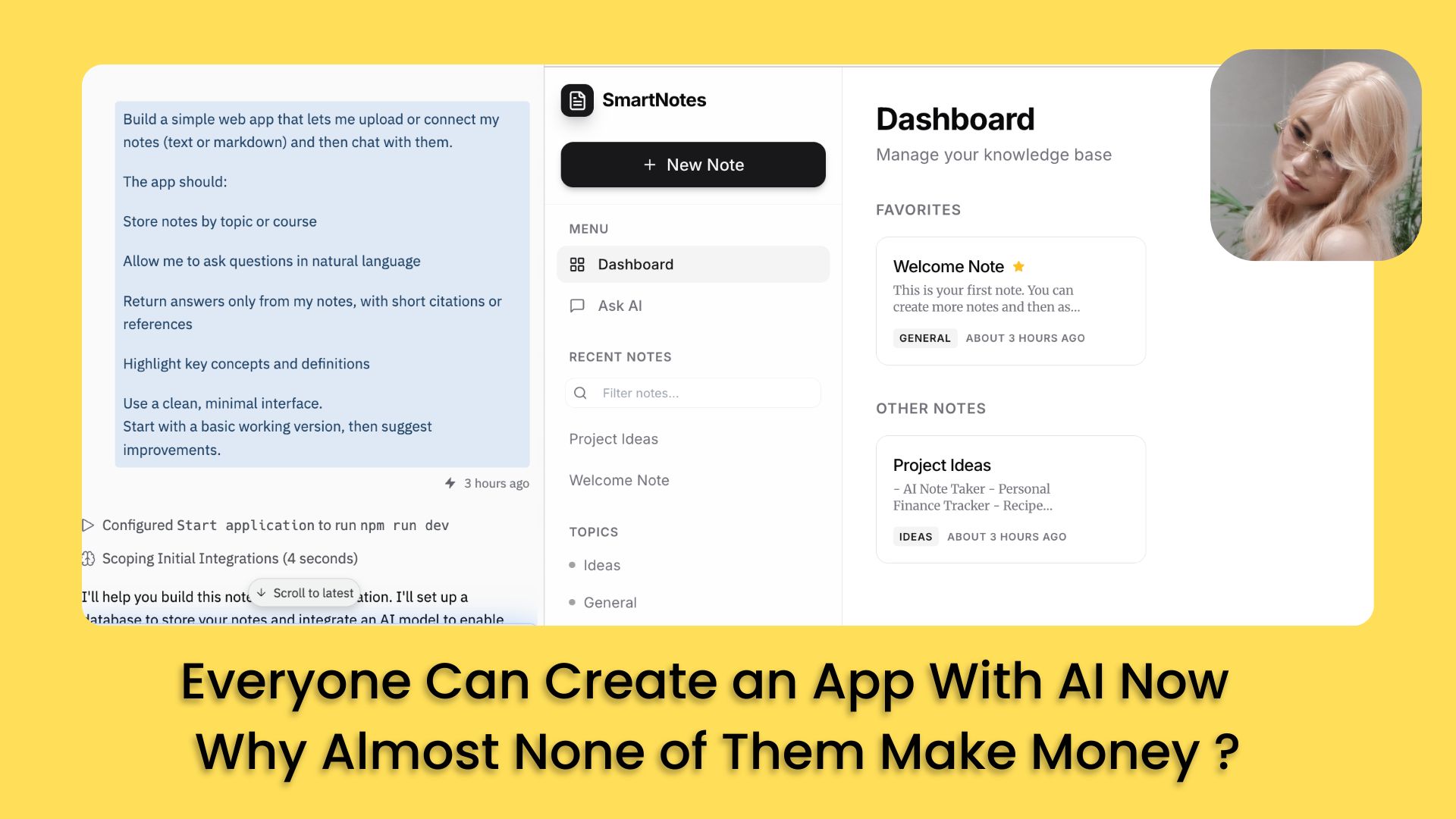
How to avoid the common traps and build AI apps that turn into real revenue.. How To Make Money With Ai, Ai Fire 101.
TL;DR
AI makes building apps fast, but speed is not the reason most apps fail. The real failure comes from poor judgment: choosing the wrong idea, at the wrong time, for people who don’t care.
This article explains why most AI apps never reach users or revenue, even when they work perfectly. It shows how to think differently about app ideas, timing, validation, and distribution so you’re not just shipping demos that disappear.
You’ll learn how to spot ideas that only work right now, why small focused problems beat big visions, how to validate before overbuilding, and why distribution must be part of the build from day one. The goal isn’t hype or scale, but building apps people actually pay for in 2025-2026.
Key points
-
AI removed build friction, but didn’t improve idea quality.
-
Timing and clarity matter more than features or polish.
-
Small, painful jobs convert faster than big platforms.
Critical insight
Most AI apps don’t fail after launch – they fail the moment the wrong idea gets chosen.
Table of Contents
Introduction
Right now, creating an app feels easier than ever. With AI, anyone can ship something in days. Yet almost all of these apps make no money and never reach real users.
The problem isn’t the tools. It’s not speed. It’s not effort.
The real issue is judgment. Choosing the wrong idea, building at the wrong time, and launching without a clear reason for anyone to care.
This article breaks down why most AI apps fail quietly and how to approach building differently. Not with hype or theory, but with a practical way to choose better ideas, validate early, and build apps people actually pay for in 2026.
I. Why Most AI Apps Fail Before Anyone Even Uses Them

1. The Illusion of the “Easy App Era”
Right now, it feels easy to create app with AI. People vibe code. They prompt models to generate features. They spin up MVPs in days instead of months.
From the outside, it looks like the hard part is gone. But after spending months building, testing, and watching others launch, the pattern is clear: most AI apps never reach real users. Not because the code fails. Because the idea never lands.
What changed is execution speed. What didn’t change is judgment.
AI removed friction from building software, but it didn’t solve the harder question: what is worth building right now? That’s why so many apps look impressive on demo day and quietly disappear afterward. They work, but they don’t matter.
2. The Real Bottleneck Most Builders Miss
A lot of beginners think speed is the advantage. “If I can build faster, I’ll win.”
That logic made sense when building took months and teams. Today, speed without direction just helps you reach the wrong destination sooner.
The real constraint now is decision quality:
-
Is this a problem people already pay to solve?
-
Does recent AI capability make this meaningfully better?
-
Can someone understand the value in seconds?
When you create app with AI, you can move incredibly fast while avoiding these questions. AI will gladly help you polish features nobody asked for. I’ve done this myself-building things that felt smart, looked clean, and generated zero traction.
II. The Shift That Made Solo Builders Viable
1. Why Coding Skill No Longer Determines Outcomes
For a long time, software worked in a very rigid way. If you couldn’t code, you couldn’t compete. Syntax was the gatekeeper, experience dictated speed, and teams always beat individuals.

That structure has quietly collapsed.
Today, when you create app with AI, outcomes are no longer decided by how many languages you know. They’re decided by whether you understand what you’re trying to build. The skill that matters now is conceptual clarity. Knowing what a page is supposed to do, how users move through a flow, how login works, where data lives, and what happens when something goes wrong. These are fundamentals, not advanced engineering topics.
Once you can describe behavior clearly, AI handles the mechanical work. That’s why complete beginners are now building real products, not demos or side projects, but apps with users and payments. The barrier didn’t disappear. It moved. Syntax matters less, judgment matters more.
This is also why learning everything upfront is no longer the right approach. You only need enough understanding to make good decisions. Everything beyond that can be filled in as you build.
2. The Real Breakthrough: Parallel AI Workflows
The biggest shift most people miss isn’t better autocomplete or cleaner code suggestions. It’s parallel execution.

In the past, app development was sequential. One person worked on the homepage, then moved to authentication, then built the dashboard. Each step waited for the previous one to finish. Even with a team, progress was gated by handoffs and reviews.
Now, when you create app with AI, multiple parts of the product can be built at the same time. One agent works on the homepage, another handles login and authentication, and a third sets up dashboard logic, all in parallel, inside the same codebase. Tasks that used to take weeks with a junior team can now be done in hours.
This changes strategy, not just speed. Faster execution means you can react to new model capabilities while others are still planning. It gives solo builders a timing advantage the market hasn’t fully priced in yet. Most people still assume software is slow, expensive, and team-dependent. If you understand parallel workflows, you’re operating under a different reality.
That gap is where opportunity lives.
III. How to Spot App Ideas That Only Work Right Now
1. The “Could This Exist One Year Ago?” Filter
This is the most important filter in this entire guide. Before you build anything, ask one question: could this app have existed one year ago in roughly the same form?
If the answer is yes, that’s a warning sign. It usually means one of two things. Either the idea has already been explored and competed away, or the margins are thin because the problem is no longer new. When you create app with AI, novelty doesn’t come from clever positioning. It comes from new capability.

The strongest ideas today rely on something that recently became possible. A cost drop. A speed jump. A quality threshold that models couldn’t cross before. If the tech didn’t support it recently, the market hasn’t fully caught up yet. That gap is where early traction comes from.
This filter alone removes most bad ideas. It forces you to stop copying things that look successful and start paying attention to timing instead.
2. Model Leaps Create Short Opportunity Windows
AI doesn’t improve smoothly. It jumps.
You’ll see sudden leaps in image quality, reasoning ability, multimodal input, or execution reliability. When those jumps happen, entire workflows that were previously clunky or expensive suddenly feel obvious.

That’s when opportunity appears.
Most people react too late. They notice after tools are everywhere, competitors are shipping clones, and users already have habits. Builders who win are watching for what just crossed the line from “almost usable” to “actually good.”
When you create app with AI around a fresh capability, you’re not fighting entrenched products. You’re giving people something they couldn’t reasonably use before.
The window doesn’t last long. Once a capability becomes obvious, platforms absorb it and competitors pile in. That’s why timing matters more than originality.
3. Fertile Ground and Spawn Camping
Good builders don’t invent markets. They arrive early to new terrain.
Every major model release creates fertile ground. New things become cheap, fast, or reliable enough to build on. The strategy is simple: track releases, understand what just became possible, then build directly on that capability.

This is sometimes called spawn camping. You’re not guessing what people might want in five years. You’re waiting at the exact moment a new tool makes a specific workflow viable.
When you create app with AI this way, you’re not forcing demand. You’re meeting it early.
Timing beats cleverness. Always.
IV. Choosing Small, Focused Problems That Win
1. Why Big Visions Kill Early-Stage Apps
Most beginners start with the wrong goal. They aim for an all-in-one platform, try to replace an existing giant, or chase something that sounds impressive on paper. The problem is that big visions slow everything down. Scope expands, feedback gets delayed, and momentum fades before the product becomes useful. This happens even faster when people first create app with AI, because speed makes overbuilding feel justified.
Big visions slow everything down. They delay feedback, stretch scope, and push real user conversations further into the future. Momentum fades long before the product becomes useful. I’ve seen this happen repeatedly, especially when people first create app with AI and feel unlimited by execution speed.

The apps that win early do the opposite. They focus on one painful step inside an existing workflow. Not the whole process. Just the part people already complain about.
That might be iteration speed.
It might be handoffs.
It might be waiting, revisions, or coordination.
When you remove friction from a single step, users feel relief immediately. That’s what gets paid for.
2. Build for a Job, Not a Market
A common question I hear is, “Is this market big enough?”
That’s the wrong starting point.
A better question is: what job does this product do better than anything else? People don’t buy apps because they belong to a market. They buy them because something annoying goes away.

Think in terms of jobs like:
-
faster iteration without back-and-forth
-
fewer people involved in a task
-
immediate feedback instead of waiting
When you create app with AI around a clear job, positioning becomes simple. You don’t need to educate users. They already understand the problem because they live with it. Your product just handles that one task better than their current workaround.
Markets can be large or small. Jobs are either painful or they aren’t. Pain wins.
3. Leverage Your Own Repetition
The strongest ideas usually aren’t new. They’re familiar.
They come from things you’ve dealt with again and again. Weekly annoyances. Tasks you outsourced multiple times. Processes that always felt slower or more expensive than they should be.

Ask yourself:
-
What frustrated me consistently over the last few years?
-
What did I keep paying other people to handle?
-
What broke or stalled at the same step every time?
Your experience gives you clarity most people don’t have. You already know the language users use, the edge cases they hit, and where existing tools fall short. That makes positioning easier and distribution more natural.
When you create app with AI from lived repetition, you don’t need to guess what matters. You’ve felt it. That’s a strong advantage, especially early on.
V. Validating Ideas Before You Overbuild

1. Why Overbuilding Is Just Procrastination
Overbuilding feels productive, especially when you create app with AI. Features ship fast, polish is easy, and progress looks real. The problem is that most of this work happens before anyone confirms they care.
What overbuilding really avoids is contact. Talking to users. Hearing confusion. Watching people ignore what you thought was obvious. Adding features becomes a safe substitute for clarity, but it doesn’t reduce risk. It increases it.
Validation needs to happen before depth and polish. Early products should feel slightly uncomfortable because they’re exposed to real judgment. If everything feels clean and complete before users react, you probably waited too long.
2. The One-Sentence Clarity Test
If someone can’t explain your product in one or two sentences, they won’t buy it. Attention is short, patience is thinner, and explanations don’t convert.
Clear examples sound boring, and that’s why they work. “Create thumbnails that get clicks.” “Generate invoices in one step.” “Turn notes into summaries instantly.” These statements don’t try to impress. They communicate outcome.
When you create app with AI, avoid abstract benefits or technical descriptions. Users don’t care how it works. They care what changes after using it. If the value isn’t obvious immediately, people leave before discovering anything else.
3. Click Count as a Product Metric
Early products should be measured in friction, not features. One of the simplest metrics to track is how many actions it takes for someone to go from landing on your site to paying.
Every extra click reduces the chance of conversion. Missing assets, unclear steps, mobile limitations, or vague copy all add friction. These issues don’t show up in code reviews. They show up when real users hesitate.
Good validation is aggressive about removal. Remove steps. Remove choices. Remove anything that slows understanding. When people convert faster, it’s usually because the product became simpler, not more powerful.
VI. Launching With Distribution

1. Why “Ship and Pray” Guarantees Failure
Most apps don’t fail because the product is broken. They fail because nobody ever sees them. Shipping without a distribution plan is the same as building in isolation and hoping luck shows up later.
When you create app with AI, it’s easy to convince yourself that launch day is the finish line. It isn’t. Launch is the start of feedback, and feedback only exists if people are already paying attention. Without distribution, there’s no signal, no learning, and no momentum. The app doesn’t die loudly. It just sits there.
Hope is not a strategy. Visibility is.
2. Why X Works Right Now for Solo Builders
Right now, X is one of the few platforms that still favors relevance over polish. Text-first content lowers effort, novelty travels fast, and small accounts can reach large audiences without production overhead.
This matters if you’re building alone. You don’t need threads, viral hooks, or perfect branding. What works is showing something real: progress, screenshots, problems you’re solving, and honest observations from building. When you create app with AI, sharing what you’re making naturally attracts the people who care about that problem.
Consistency beats cleverness here. Posting regularly about a specific pain trains the algorithm and the audience at the same time.
3. Building in Public Without Becoming a Creator
A lot of builders avoid sharing because they don’t want to become creators. That fear is misplaced. Building in public doesn’t mean performing. It means documenting.
You can post what you fixed today, what confused users, or what broke in production. No storytelling framework needed. Signals matter more than aesthetics. When people see progress tied to a real problem, trust builds naturally.
Distribution works best when it’s attached to the work itself, not layered on later. If you wait until the app is finished, you start from zero attention instead of warming an audience over time.
4. Paid Traffic Is a Skill, Not a Switch
Paid ads don’t replace distribution. They amplify it. Expect wasted spend early. That’s part of the learning curve. Running ads without organic signal usually burns money without teaching much.
The most effective use of paid traffic is reinforcing what already resonates. Retarget people who interacted, clicked, or replied. Use ads to speed up learning, not to manufacture demand.
When you create app with AI, marketing still follows the same rule it always has: clarity first, amplification second.
VII. Why Most Apps Die After Ship Day

1. The Fear of Big Companies Is a Mental Trap
One of the quiet killers of momentum is fear. Fear that a big company will copy the idea. Fear that a platform will absorb the feature. Fear that all this effort won’t last.
That fear sounds logical, but it’s usually misplaced. Large companies move slowly. Decisions pass through layers of approval, internal politics, and conflicting priorities. Even when they notice a smaller product, execution takes time.
When you create app with AI, speed is your advantage. A twelve-month window is longer than it sounds. It’s enough time to get users, learn what works, and build revenue. Waiting because someone bigger might act someday just guarantees you won’t.
2. You Don’t Need to Win Forever
A lot of builders quit because they believe success has to be permanent. They think the product must dominate, scale endlessly, or defend its position for years. That belief creates pressure and hesitation.
Early-stage apps don’t need longevity. They need proof. Proof that people care, proof that money changes hands, proof that you can take an idea from zero to demand. From there, outcomes vary. Some products generate steady cash flow. Some get acquired. Some fade after doing their job.
When you create app with AI, the goal isn’t to own a category. It’s to learn fast while earning. That mindset removes unnecessary weight and makes shipping easier.
3. Compounding Is the Real Game
The real payoff rarely comes from the first app. It comes from what you carry forward.
The first product teaches judgment.
The second sharpens distribution.
The third usually makes money.
Each build compounds skills faster than the product itself compounds revenue. You start recognizing patterns, avoiding mistakes earlier, and moving with confidence instead of guesswork.
Most apps don’t fail because they were bad ideas. They fail because builders stopped too soon. If you keep shipping, learning, and adjusting, progress becomes inevitable.
VIII. Beginner Method (Step-By-Step)
If you want to create app with AI as a beginner, this is the process that actually holds up.

Step 1: Track Model Capability Shifts Weekly
You don’t need to live on AI Twitter or read every research paper. You just need a light, consistent pulse on what changed. New model releases, capability jumps, cost drops, or reliability improvements are signals. Each shift quietly removes a constraint that used to block certain workflows.
Most people notice these changes late, after tools are everywhere. You’re aiming to notice them early, when things feel possible but still uncommon.
Step 2: Ask “What Just Became Possible?”
Every capability shift creates new room to build. Ask what workflows suddenly feel simpler, cheaper, or fast enough to be useful. This isn’t about inventing something clever. It’s about recognizing that a previously annoying process can now be compressed into a few steps.
When you create app with AI around a fresh capability, you’re not forcing adoption. You’re offering something people already wanted but couldn’t reasonably get before.
Step 3: Match That With Your Own Experience
Don’t search for ideas in random industries. Look inward. The best candidates usually sit at the overlap between new capability and personal repetition. If you’ve dealt with a problem often enough to feel bored explaining it, that’s useful context.
Your experience reduces guessing. You already know what matters, what doesn’t, and where existing tools fall short. That alone puts you ahead of most beginners.
Step 4: Define One Job, One Outcome
Clarity matters more than ambition. Decide on one job the app does and one outcome it delivers. Keep it narrow enough that someone understands it instantly. If you can’t describe it in a short sentence, it’s still too broad.
This step is where most projects either sharpen or collapse. A focused job keeps decisions simple later.
Step 5: Validate With Clarity, Not Code
Before adding depth, check understanding. Show a basic version, a landing page, or even a mock flow. Pay attention to reactions. Confusion means something needs tightening. Interest means you’re close.
Building features before this point is usually avoidance. Validation happens through exposure, not polish.
Step 6: Launch With Distribution Built In
Don’t wait until the app feels finished. Share progress, screenshots, and lessons as you build. Distribution works best when it grows alongside the product. Even a small, relevant audience is enough to generate feedback and early users.
When you create app with AI, attention is part of the product. Treat it that way from day one.
Step 7: Iterate Relentlessly, Ignore Noise
Early feedback will be messy. Some suggestions help. Others distract. Your job is to notice patterns, not react to every comment. Improve the core job, remove friction, and keep the loop tight.
Progress compounds faster when you stay focused.
Conclusion
Right now, the gap isn’t created by talent or credentials. It’s created by attention and timing. The people who win are the ones who notice small shifts early, recognize what those shifts enable, and make clean decisions before everything feels obvious.
Awareness comes first. Seeing new capabilities as they appear, not months later when tools are everywhere. Judgment follows. Choosing problems that are specific, painful, and already part of someone’s routine. Then comes the step most people delay: shipping early enough to learn while the window is still open.
When you create app with AI, the advantage isn’t access to technology. That part is already commoditized. The advantage comes from acting while others are distracted by hype, debating tools, or polishing ideas that never reach users.
This period rewards momentum over perfection. Clear thinking beats big visions. Early feedback beats long planning cycles. Builders who move with focus, test quickly, and adjust based on reality will keep pulling ahead.
That’s what makes 2025-2026 different. Not AI itself, but the opportunity to move early while most people are still watching, waiting, or overthinking.
If you are interested in other topics and how AI is transforming different aspects of our lives or even in making money using AI with more detailed, step-by-step guidance, you can find our other articles here:
-
This “Super Agent” Update Changed How You Work (ChatGPT Can Compete or Not?)
-
The “Lazy” AI Flywheel: How I’d Build Income With 10 Tools in 2026
*indicates a premium content, if any
Leave a Reply