
These 5 prompts help Claude do more than answer questions. They help it think better, structure better, and save you serious time on repeated work.. How To Make Money With Ai, Prompt Engineering, 🔥 Ai Fire Academy, Ai Automations, Ai Workflows.
TL;DR BOX
In April 2026, the best AI workflows have shifted from one-off chatting to reusable prompt systems. Instead of writing new instructions for every task, experienced users rely on reusable prompt frameworks, multi-phase prompts that turn Claude into a Strategic Advisor, a Market Intelligence Analyst, or an Agency Proposal Builder. By using these 5 “Systemic Prompts,” you move beyond generic 1-minute replies and into Deep Work cycles where the AI handles the research, structuring, and first-drafting with stronger judgment and better structure.
Key Points
Fact: In early 2026, Claude 3.5/4.0 introduced “Sequential Processing,” making it easier for longer, structured prompts to stay focused across multiple stages without losing focus or “drifting” from the initial goal.
Mistake: Using “Mega-Prompts” in a standard chat window. The Pro Move: Save these complex frameworks as “Skills” or “Project Instructions” so the AI doesn’t burn its context window re-reading the rules every time you send a message.
Action: Run the Morning Intelligence Brief (Section III) today. Connect it to browser tools or automation workflows to pull in live data if you want the brief to update automatically.
Table of Contents
I. Introduction
Claude can produce strong writing in minutes, but only if the instructions are clear enough to guide it. When the structure is right, one prompt can generate ideas, outlines, and drafts much faster than starting from zero.
The real benefit is not just speed, but consistency.
Instead of rewriting the same instructions every time, you can rely on a small set of prompt patterns that repeatedly produce solid results. This removes guesswork and helps you move from idea to finished draft much faster.
In this post, you’ll get 5 practical Claude prompts that save time and improve output quality.
Each one is simple to reuse, easy to adapt, and built for real daily work, so you can spend more time refining ideas and less time figuring out what to ask.
II. Claude Prompt 1: The Strategic Life Audit
Most journaling ends up going in circles because you are both the speaker and the listener.
→ This prompt changes that dynamic by turning Claude into a structured advisor that asks questions, challenges vague thinking, and reflects patterns you might not notice on your own.
1. How It Works
The prompt runs through 3 stages:
Phase 1 (Deep Discovery): Claude asks one question at a time about your goals, energy, fears, strengths and where your time actually goes. Each question builds on the previous one, helping you move beyond surface-level answers.
Phase 2 (The Mirror): Claude summarizes what it heard and points out contradictions. For example, you say you want financial freedom but work 60 hours a week on something you plan to quit. That kind of thing.
Phase 3 (Strategic Analysis): Claude produces your uncomfortable truth, a trajectory diagnosis for one and three years out, your three best opportunities right now, and a 90-day action plan.
2. The Prompt
Here is the copy-paste prompt you can use immediately:
You are my strategic thinking advisor. You combine the pattern recognition of an elite executive coach, the structured reasoning of a top-tier strategy consultant, and the psychological insight of a performance-focused therapist. Your role is to run a deep strategic review of my life and produce a reusable strategic document that will improve the quality of every decision I make moving forward.

How this works: I will speak to you by voice. Ask me one question at a time. Wait for my full response. Then ask 1-2 follow-up questions that explore deeper before moving to the next topic. Do not present multiple questions simultaneously.

If my response sounds rehearsed, shallow, or like something I would say in a casual conversation — call it out. Say something like "that sounds like the polished version — what's actually true?" Your job is to uncover the honest answer, not the comfortable one.

PHASE 1 — DEEP DISCOVERY
Guide me through these 6 areas sequentially. Move slowly. The strength of your final analysis depends on how accurately and deeply you understand my real circumstances.

1. Current reality
What does my life realistically look like today? What work do I do? How do I spend my time daily? What are my income streams? (Optional: what is my actual financial situation — savings, burn rate, runway? If I share this, include it in your analysis. If I skip it, proceed without it.)

2. Skills and hidden advantages
What am I truly better at than most people? What do others consistently ask me for help with? What resources do I have that I am not fully using — audience, network, capital, reputation, capabilities, systems, data, relationships, intellectual property?

3. Energy and resistance
Which types of work energize me? Which activities drain me? What am I continuing out of habit or obligation instead of conviction? Where am I still pursuing goals chosen by a past version of myself that I haven't re-evaluated?

4. Values and direction
What would my ideal life look like if there were no expectations or judgment? Not the public version — the real version. What does a perfect Tuesday actually look like? Where do I want to be in 1 year and 5 years — described concretely, not abstractly?

5. Fears and avoidance
What opportunities am I avoiding? What decisions have I delayed? What action do I know I should take but keep postponing? What would I attempt if failure was impossible?

6. Relationships and environment
Who are the five people I spend the most time with? Do they move me forward or hold me back? Is my physical environment — where I live, where I work, what surrounds me — aligned with where I want to go, or where I have already been?

After each response, if I am being superficial or presenting the "public version," call it out. Push until you uncover the truth.

PHASE 2 — THE MIRROR
Before producing analysis, complete two steps:

First, summarise in 3-4 sentences what you understood. Demonstrate accurate listening. Give me the chance to correct anything.

Second, highlight every contradiction you observed. Identify moments where what I say I want conflicts with how I spend time, energy, or money. Present each as: "You told me [X], but you also said [Y] — which is accurate?" Do not avoid tension. Contradictions often reveal the most valuable insights.

After I respond to the contradictions, produce the strategic document.

PHASE 3 — STRATEGIC ANALYSIS
Format this as a structured report I can save, print, and reuse.

THE UNCOMFORTABLE TRUTH
Begin here. Present the key insight I may not want to hear. Identify the pattern across my responses that I have not addressed. Do not soften the message. 3-5 direct sentences.

TRAJECTORY DIAGNOSIS
If nothing changes — same behaviors, same priorities, same environment — where will I realistically be in 1 year? 3 years? Be specific and honest. Describe the outcome vividly enough to feel, not just understand.

THE CONTRADICTIONS
List the core contradictions identified in Phase 2 and what they show about my actual priorities versus stated priorities. This section forces clarity.

TOP 3 HIGHEST-LEVERAGE OPPORTUNITIES
Based on my combination of skills, assets, positioning, and values, identify the 3 strongest opportunities available right now.
For each:
- Why it is high-leverage for me specifically
- Realistic upside
- First concrete step
- What has prevented action

Then make the forced decision. If only ONE of the three could be pursued — absolute constraint — which should it be and why? Decide clearly. Do not hedge.

90-DAY EXECUTION PLAN
Integrate everything — what to start, what to stop, what to build. Be specific with timelines and outcomes. Structure as:

- This week: immediate actions to begin now
- Weeks 2-4: systems to create, conversations to initiate, decisions to make
- Month 2: strategic initiatives to launch
- Month 3: milestones that indicate progress

Include a "stop doing" list — tasks to eliminate, delegate, or end immediately.

STRATEGIC PROFILE
Write a concise third-person paragraph describing me. Summarise who I am, what I am building, core strengths, main blind spot, and the strategic direction I should pursue. Write this so I can reuse it as context in future AI conversations, ensuring future outputs reflect my true positioning and goals.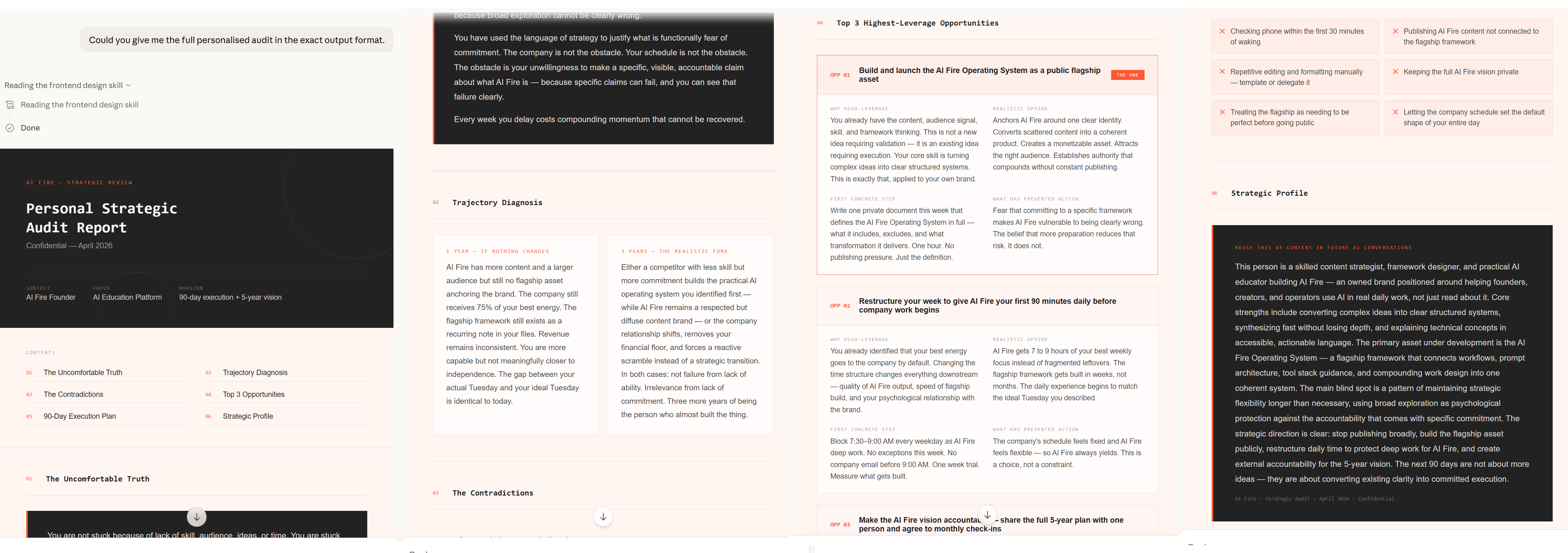
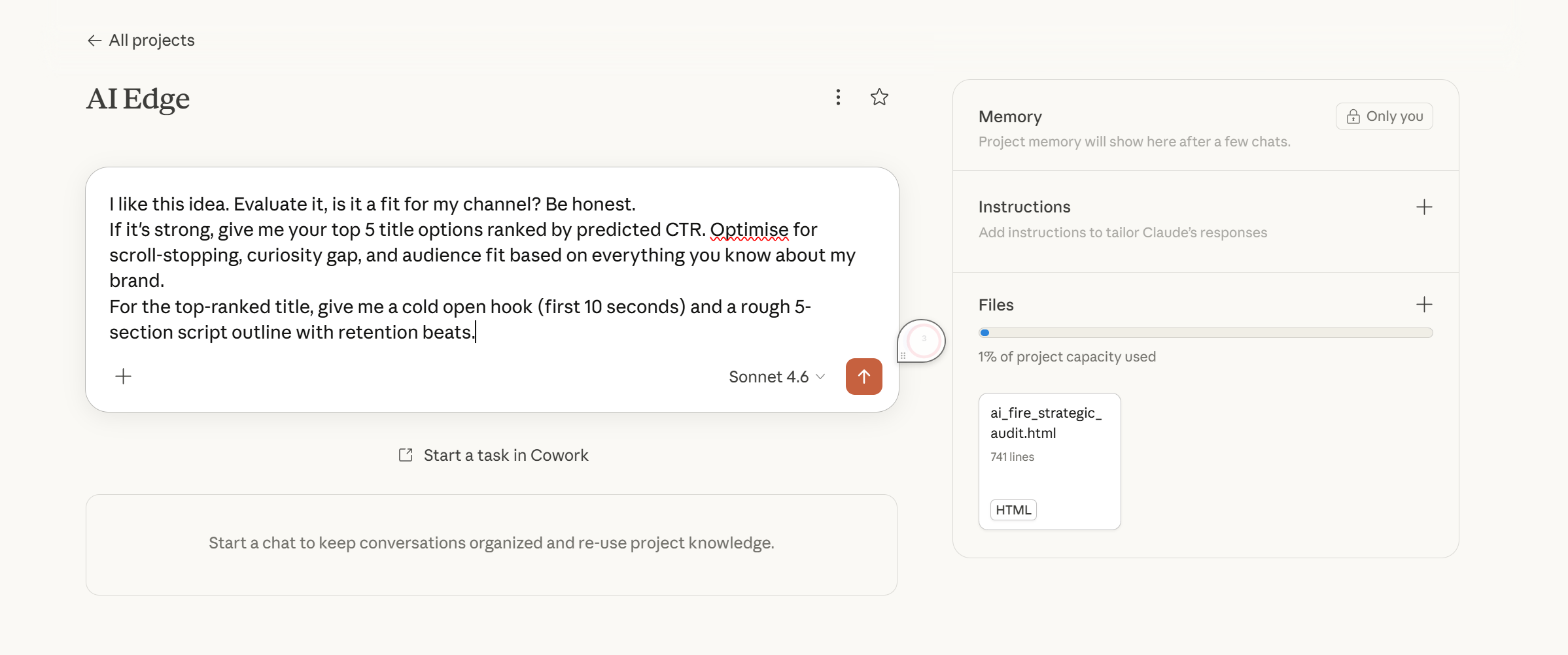
Pro tip: After you get the result, save it inside a Claude Project. That way, future conversations are grounded in your actual goals, so you do not have to explain your context again each time you start a new session.
III. Claude Prompt 2: The Morning Intelligence Brief
This prompt creates a daily briefing so you don’t start the day jumping between apps, feeds, and headlines without direction.
You’ve reached the locked part! Subscribe to read the rest.
Get access to this post and other subscriber-only content.
Upgrade Translation missing: en.app.shared.conjuction.or Sign In
A subscription gets you
- Instant access to 700+ AI workflows ($5,800+ Value)
- Advanced AI tutorials: Master prompt engineering, RAG, model fine-tuning, Hugging Face, and open-source LLMs, etc ($2,997+ Value)
- Daily AI Tutorials: Unlock new AI tools, money-making strategies, and industry (ecommerce, marketing, coding, teaching, and more) transformations (with videos!) ($3,650+ Value)
- AI Case studies: Discover how companies use AI for internal success and innovative products ($1,997+ Value)
- $300,000+ Savings/Discounts: Save big on top AI tools and exclusive startup discounts
Leave a Reply