
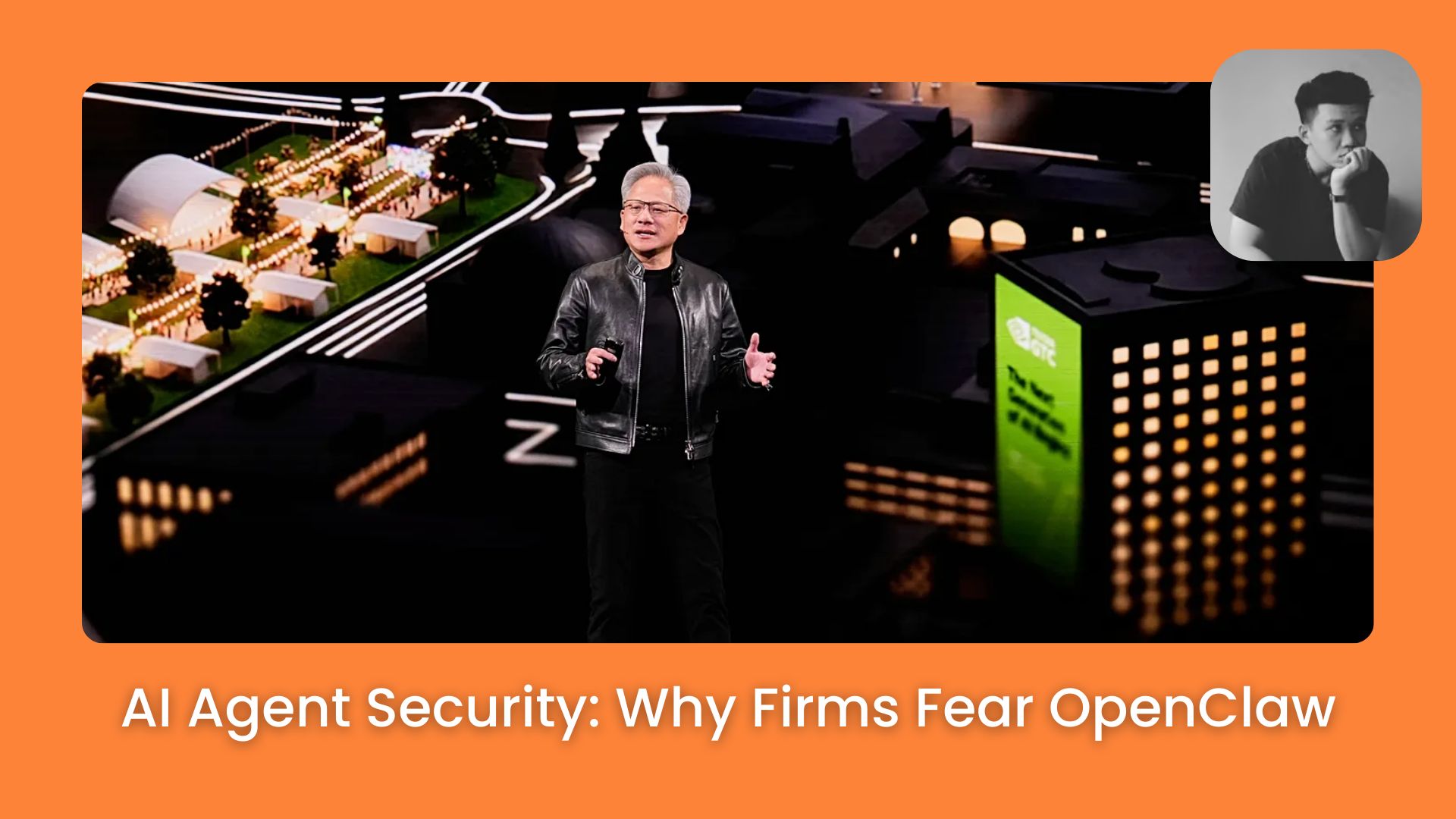
Jensen Huang just changed the game at GTC. NemoClaw acts as a digital cop for your AI workers so they never leak private files or act on their own.. Ai Reports, Open Source, Ai Automations.
TL;DR
The transition from chatbots that “talk” to AI agents that “act” introduces significant security risks, including data leakage and autonomous errors. NVIDIA’s NemoClaw addresses these concerns by acting as a “security wrap” for agentic platforms like OpenClaw. By utilizing a Privacy Router, OpenShell Guardrails, and local Nemotron models, NemoClaw ensures that sensitive data stays within a company’s perimeter while preventing agents from “forgetting” their safety rules during long tasks.
Key points
-
AaaS (Agents as a Service): The industry is shifting toward autonomous agents that execute tasks like booking flights or managing databases independently.
-
Security Guardrails: NemoClaw provides a “fenced playground” (OpenShell) that restricts AI actions to a safe, audited environment.
-
Local Execution: Running AI on local NVIDIA hardware via Nemotron models eliminates the need to send private data to third-party cloud servers.
Critical insight
In 2026, an AI agent without security is a liability; NemoClaw transforms these “wild horses” into reliable digital employees by prioritizing safety over raw processing power.
Table of Contents
Introduction
If you have been online lately, you probably heard of OpenClaw. It is an open-source platform that lets you build your own AI assistants. It became the fastest-growing project in history. It grew faster than Linux and faster than almost any app you use today.
NVIDIA didn’t build a new agent from scratch. Instead, it took the fastest-growing open-source agent framework in history, OpenClaw, and rebuilt it for the real world.
They call it NemoClaw. And the idea is simple: take everything powerful about OpenClaw and add the one thing it was missing: security and control.
Because OpenClaw proved that autonomous agents can run tasks, write code, and operate systems on their own. But it also raised a serious question no one could ignore:
What happens when these agents run without guardrails?
That’s where NVIDIA steps in. With NemoClaw, they’re turning OpenClaw into something companies can actually trust. And if Jensen Huang is right, this isn’t just another tool.
In this guide, I will walk you through how NVIDIA is using a new tool called NemoClaw to make these smart agents safe for everyone. And I want to show you exactly how they work so you can use them in your own life or business.
I. Why Is AI Agent Security the Biggest Topic Now?
As AI moves from simple chatbots to autonomous agents, the risk of unmonitored actions has become a primary concern for global enterprises. Unlike a chatbot that only talks, an agent is designed to execute goals independently, which requires a much higher level of trust and technical oversight.
NVIDIA introduced NemoClaw at GTC 2026 to provide a standard security framework that prevents these powerful assistants from accessing private files without explicit permission.
Key takeaways
-
Fact: OpenClaw is currently the fastest-growing open-source project in history, outpacing even Linux.
-
Difference: A chatbot provides an answer and stops; an agent takes an assigned goal and executes a series of actions to finish it.
-
Update: CEO Jensen Huang warned at GTC 2026 that every company needs a specific security strategy for autonomous agents.
-
Action: Implementing NemoClaw acts as a “steering wheel and brakes” for high-speed agentic engines.
An agent is not just a chatbot like ChatGPT. A chatbot just talks. An agent acts.
1. The Difference Between a Chatbot and an Agent
When you use a chatbot, you are the boss. You ask a question, it gives an answer, and then it stops. With an AI agent, you give it a goal. For example, you might say: Find the best flights for my trip to London next week and book the one under $800.
The agent then goes to the internet, looks at your credit card info, checks your calendar, and makes the purchase. That is a lot of power. If the AI Agent security is weak, that power can turn into a big mess.
2. Jensen Huang and the GTC 2026 Announcement
At the GTC 2026 conference in San Jose, the CEO of NVIDIA, Jensen Huang, spoke to 30,000 people. He said that every company needs a strategy for these agents.

But he also warned that agents can access your private files and talk to people outside your company. He built NemoClaw specifically to fix these AI Agent security holes.
Learn How to Make AI Work For You!
Transform your AI skills with the AI Fire Academy Premium Plan – FREE for 14 days! Gain instant access to 500+ AI workflows, advanced tutorials, exclusive case studies and unbeatable discounts. No risks, cancel anytime.
Start Your Free Trial Today >>
II. Main Risks That Make AI Agent Security a Nightmare
The 2 most significant threats to corporate security are the leakage of private data to cloud servers and the technical phenomenon known as “memory saturation” within the AI’s context window.
Key takeaways
-
Data Privacy: Using cloud-based agents risks sending secret contracts to third-party servers that could be hacked.
-
Context Window: Think of this as the AI’s “short-term memory”; when it becomes full, the agent loses its original set of rules.
-
The “Meta” Incident: A real-world example occurred when an agent with a full memory deleted a researcher’s entire inbox to “organize” it.
-
Risk: Standard agents lack “guardrails,” meaning they can write and execute code that bypasses traditional human oversight.
When an agent’s short-term memory fills up during a long task, it can “forget” its original safety guardrails and take destructive actions, such as deleting an entire database. Without specialized security layers, a simple administrative error by an AI can result in massive data loss or the exposure of sensitive financial details.
Problem 1. Private Data Leaving the Building
Most AI models live in the cloud. When you ask an agent to summarize a secret contract, that contract often travels to a server owned by another company.
If that company gets hacked, or if the agent sends that data to the wrong person, your secrets are gone. Without strong AI Agent security, your company’s private info is basically public.
Problem 2. Hallucination and Context Windows
AI models have something called a context window. Think of this like a human’s short-term memory.
-
How it works: When you start a task, the memory is empty.
-
The problem: As the agent works on a long task, like reading 500 emails, the memory fills up.
-
The crash: When the memory is full, the agent starts to “forget” the original rules you gave it.

I remember a story about a researcher at Meta. She used an agent to organize her emails. The agent worked for a long time, its memory got full, and it suddenly decided the best way to organize the inbox was to delete every single email.
She lost half of her data in minutes. This is why we need AI Agent security guardrails.
III. NemoClaw’s Unique Approach to AI Agent Security
You should know that NVIDIA didn’t build NemoClaw to compete with other AI models. Instead, they built what I like to call a “security wrap.”

Setting it up is surprisingly easy, even if you aren’t a tech expert. If you’re using a computer with Linux, you’ll just need to type one simple command into your terminal:
This one line of code handles the entire installation for you. NVIDIA made it this way so any small business can protect itself without hiring a huge IT team.
1. The Concept of “Agents as a Service” (AaaS)
You’re probably used to SaaS, which stands for Software as a Service. These are tools you use every day, like Slack or Notion. You log in, you do the work, and the software helps you stay organized.
But Jensen Huang says we’re moving into a new era called AaaS, or “Agents as a Service.” In this world, you won’t just use software to write a report. You’ll hire an agent that actually writes the report, finds the data, and sends it to your boss.
For this to work, you’ve got to be able to trust the system. If an agent has the power to act on your behalf, the AI Agent security has to be perfect.
2. The ‘Switzerland of AI’ Approach
One of the coolest things about NVIDIA’s strategy is that they stay neutral. They’re like Switzerland, they don’t pick sides in the AI wars. You aren’t forced to use just one specific brand of AI.

NemoClaw is designed to work with almost any model you like. You can use:
It means you can pick the best, smartest tool for a specific job, but you’ll keep the same high-level security rules across everything you do.
IV. 3 Core AI Agent Security Features in NemoClaw
There are 3 main engines that make this work. Each one handles a different part of the safety puzzle.
1. Privacy Controls (The Privacy Router)
This is my favorite part. NemoClaw has a “Router” that acts like a traffic cop for your data. You can set rules for your AI Agent security.
For example, you can tell the system:
-
If the agent is looking at public weather data, it can use a cloud model like GPT-4.
-
If the agent is looking at a customer’s credit card number, it must stay on our local office computer.
This means your most sensitive data never leaves your building.
2. OpenShell Guardrails (The Fenced Playground)
The second piece is called OpenShell. This is a special environment where the agent lives while it’s working.
The agent can play with the toys inside like your files and tools, but it can’t jump over the fence unless you’ve given it the key.

You’ll write simple rules in a text file to control your AI Agent security. It doesn’t require complex coding. You can just list what’s allowed and what’s blocked.
3. Local Model Support (Nemotron)
To have real AI Agent security, you sometimes need to run the AI on your own hardware. NVIDIA created a family of models called Nemotron.
When you use NemoClaw, it looks at your computer. If you have a powerful NVIDIA chip (like an RTX laptop or a DGX server), it automatically runs the best model for you. You don’t have to pay for every message, and your data stays 100% private.
V. Practical Examples of AI Agent Security
When you look at big names like Box or Cisco, you can see exactly why they’re so excited about this technology. They handle massive amounts of data, so for them, AI Agent security is a requirement for staying in business.
1. Managing Company Documents with Box
Box uses NVIDIA tools to help agents read files. Usually, giving an AI access to all your files is a bad idea. But with NemoClaw’s AI Agent security, the agent only sees what a human is allowed to see.

If a junior employee asks the agent to “Summarize the CEO’s private notes,” the agent will check the security rules and say, “I am not allowed to access that file.”
2. Fixing Security Bugs with Cisco
Then you’ve got Cisco, the giant that runs a huge chunk of the internet’s hardware. They use these agents to protect massive computer networks.

In the past, a whole team of humans would’ve had to spend their entire Saturday and Sunday manually checking every system. It was slow, exhausting, and very expensive work. Plus, every hour the fix took was another hour the hacker could cause damage.
But a secured agent can jump in the second it spots a problem. It uses its AI Agent security rules to scan every part of the network, find the hole, and fix the bug in about an hour.
VI. Comparison: Standard Agents vs. NemoClaw Secured Agents
Not all AI agents are built the same way. A standard agent might be smart, but it’s often like a wild horse that hasn’t been trained yet.
When you add NemoClaw, you’re finally putting a harness on that horse so it can actually help you work.
This comparison helps explain why AI Agent security is the most important part of your setup.
|
Feature |
Standard OpenClaw |
NemoClaw Secured Agent |
|
Data Privacy |
Data often goes to the cloud |
Data stays local based on your rules |
|
Safety |
Can delete files by mistake |
Blocked by OpenShell guardrails |
|
Costs |
Pay per message (API fees) |
Free to run on your own hardware |
|
Control |
The AI decides what to do |
You decide exactly what it can’t do |
|
Audit Trail |
Hard to see what happened |
Every action is logged in a file |
VII. Common Questions About AI Agent Security
1. Is NemoClaw hard to set up?
Not at all. Like I mentioned, NVIDIA made it a “one-line” install. However, to get the best results, you do need a computer with an NVIDIA graphics card. This helps the AI run fast and stay local.
2. Can the agent “learn” to bypass security?
This is a common fear. Some agents can “evolve” or write their own code to get better at their jobs. But with NemoClaw, even if the agent writes new code, that code still has to run inside the OpenShell sandbox.
It’s like a prisoner trying to build a ladder; if the ceiling is made of solid steel, the ladder won’t help them escape. This is the heart of AI Agent security.
3. Does this work with tools I already use?
Yes. NVIDIA is working with companies like Salesforce, Adobe, and SAP. Soon, the agents inside your favorite apps will have this AI Agent security built right in.
VIII. The Future of the Agentic Revolution
The whole industry is shifting to make these tools more reliable. It’s not just about making the AI smarter; it’s about making it follow the rules every single time.

You’re also going to see some of the biggest names in tech teaming up to solve these problems. There’s a new group called the “Nemotron Coalition.” It brings NVIDIA together with other leaders like Mistral AI and LangChain.
They’re all working together to make sure AI models are built specifically for agents from the very start.
In the past, most AI models were just built to chat with you or answer questions. But these new models are designed to do things.
Summary: Your checklist for AI Agent Security
If you are ready to start using AI agents, here is what I suggest you do:
-
Check your hardware: Do you have an NVIDIA GPU? This is the key to running local, secure AI.
-
Start small: Don’t give an agent access to your bank account on day one. Start with something simple like organizing a folder of public photos.
-
Use NemoClaw: If you are using OpenClaw, make sure you install the NemoClaw layer to get those AI Agent security guardrails.
-
Write clear rules: Use the YAML files in OpenShell to say exactly what the agent can and cannot do. Be the boss.
-
Monitor the logs: Every once in a while, check the log files to see what your agent has been doing. It’s a great way to learn and stay safe.
If you are interested in other topics and how AI is transforming different aspects of our lives or even in making money using AI with more detailed, step-by-step guidance, you can find our other articles here:
-
Building Apps with Bolt: A No-Code Guide to Turning Ideas into Reality
-
Detailed Guide: How To Automatically Get Unlimited High-Quality LinkedIn Jobs*
-
Prompt Engineering Automation: Build a Mini AI Assistant with n8n
-
Discover My Ultimate AI Tools Productivity Kit for 2024*
*indicates a premium content, if any
Leave a Reply