
You don’t need to build the next viral AI app. I’ll show you a 6-tier framework and why blue-collar work around data centers and energy is where the real, steady money lives. How To Make Money With Ai, Ai Reports, Ai Startups.
TL;DR BOX
In 2026, the AI economy has already moved on from the “flashy app” gold rush to something more durable: boring but powerful infrastructure. The real profit is no longer in consumer AI “wrappers” but in the boring systems (power, cooling and physical construction) that keep models running.
The “Six-Tier Framework” identifies Tier 2 (Data Centers & Trades) and Tier 0 (Energy) as the highest-value opportunities for non-technical individuals. And with something like 95% of AI pilots failing to show real ROI, businesses are now desperate for reliable “picks and shovels” instead of the next shiny app. While technical founders can find success in Tier 4 (Orchestration Tools), the massive shortage of skilled labor (projected at a shortage of 140,000 electricians by 2030) makes blue-collar trades the current “hidden goldmine”.
Key points
-
Stat: US data centers will triple their power consumption by 2030, creating a $3 trillion infrastructure investment cycle in the AI economy.
-
Mistake: Building Tier 5 “AI apps” (wrappers) which are being commoditized by tech giants faster than they can scale.
-
Action: Pivot existing service businesses (electrical, plumbing, HVAC) toward data center maintenance where contracts are long and competition is thin.
Critical insight
The safest bet in the AI economy is physical defensibility; while AI can write code or generate images, it cannot wire a transformer or install a liquid cooling system.
Table of Contents
I. Introduction: The AI App Bubble is Bursting
Right now, everybody is launching AI apps: email tools, writing assistants, image generators, productivity widgets,… And most of them will be gone in two years.
The “gold rush” phase of the AI economy is over. You can’t just slap AI onto a product and expect it to pay your bills. In the 1849 California Gold Rush, most miners went broke; the ones who built real wealth sold shovels, tents and jeans to the miners.
After a few months of digging through where money is actually going in 2026, I kept seeing the same pattern. The real cash isn’t in the flashy apps at all. It’s in the boring layers underneath (the power, cooling and construction) that keep everything running.
So in this guide, I want to show you the 6 layers of the AI economy and where normal people like us can actually build durable, non-hype businesses.
II. The Six-Tier Framework: Understanding the AI Stack
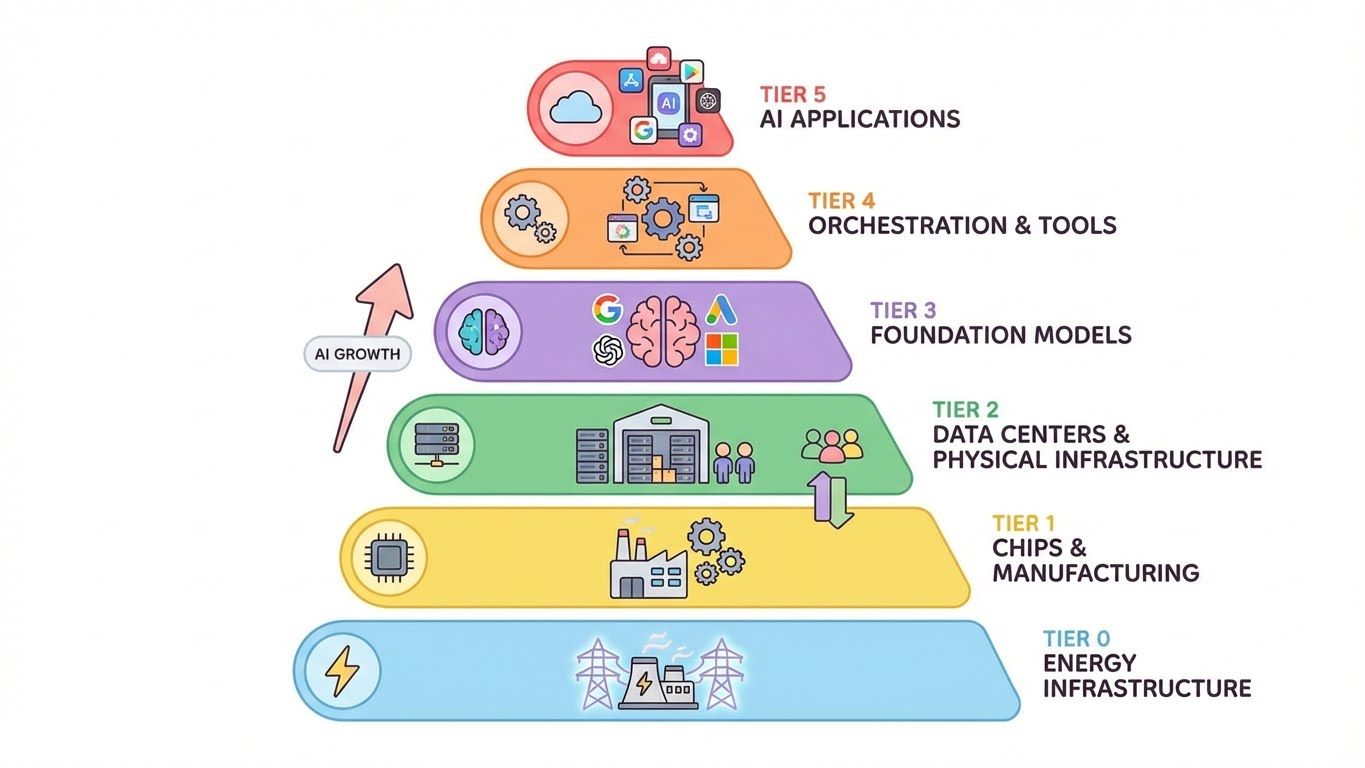
You can think of the AI economy as a building. Everyone sees the penthouse at the top (the cool apps) but nobody looks at the underground (the foundation, the plumbing or the electrical grid keeping the lights on).
That underground layer is where the real structure and the real money live.
Here is the overview of the 6 layers of the AI economy:
|
Tier |
Layer |
What It Includes |
Reality Check |
|---|---|---|---|
|
Tier 0 |
Energy Infrastructure |
Power grid, electricity, energy generation |
AI runs on power. Demand is exploding. Slow, boring, essential. |
|
Tier 1 |
Chips & Manufacturing |
Semiconductor fabs, GPU makers, equipment suppliers |
Capital-intensive. Hard to enter. Huge leverage if you’re inside. |
|
Tier 2 |
Data Centers & Physical Infra |
Server warehouses, cooling, networking, construction |
Real, blue-collar opportunities. Not crowded. Underhyped. |
|
Tier 3 |
Foundation Models |
OpenAI, Google, Microsoft |
Requires billions. Winner-take-most. Not realistic for small teams. |
|
Tier 4 |
Orchestration & Tools |
Middleware, automation, AI ops, integration tools |
Strong opportunity zone. Less crowded than apps. Needs skill. |
|
Tier 5 |
AI Applications |
SaaS apps, consumer tools, wrappers |
Most crowded. Lowest moat. Highest failure rate. |
The opportunity gets worse as you move up. The penthouse looks glamorous but the foundation is where the money lives. So, let’s break down the stack from the dirt up to the cloud.
III. Tier 0: Energy Infrastructure (The Hidden Goldmine)
AI runs on a lot of electricity. Training and running large models eat power at a massive scale. Every chat, image or automation pulls power from the electrical grid. And the grid wasn’t built for this.
The U.S. power system is old. It was designed for factories and homes, not endless data centers that consume as much electricity as small cities. Now those data centers are popping up everywhere and utilities are struggling to keep up.
1. Where the Opportunity Hides
The real upside isn’t in flashy AI startups. It’s in the boring infrastructure that has to support them:
-
Electrical contracting companies are upgrading grid capacity. Small firms are getting flooded with contracts to handle data center power installations.
-
Energy storage, like batteries, backup power systems and uninterruptible power supplies. Every data center needs redundancy.
-
Power generation, especially renewables. AI companies are facing pressure to offset their carbon footprint. Solar and wind installations near data centers are booming.
-
Grid management software and services that help utilities handle the increased load.
These are not new industries. They’re long-standing, local businesses that suddenly have more demand than they can handle. That’s where the opportunity hides.
According to S&P Global, data centers in the U.S. are exploding. Power demand is set to jump by about 22% by the end of 2025 and is on track to nearly triple by 2030. And this doesn’t even count enterprise data centers run by big tech companies like Amazon, Apple, Google, Meta or Microsoft.
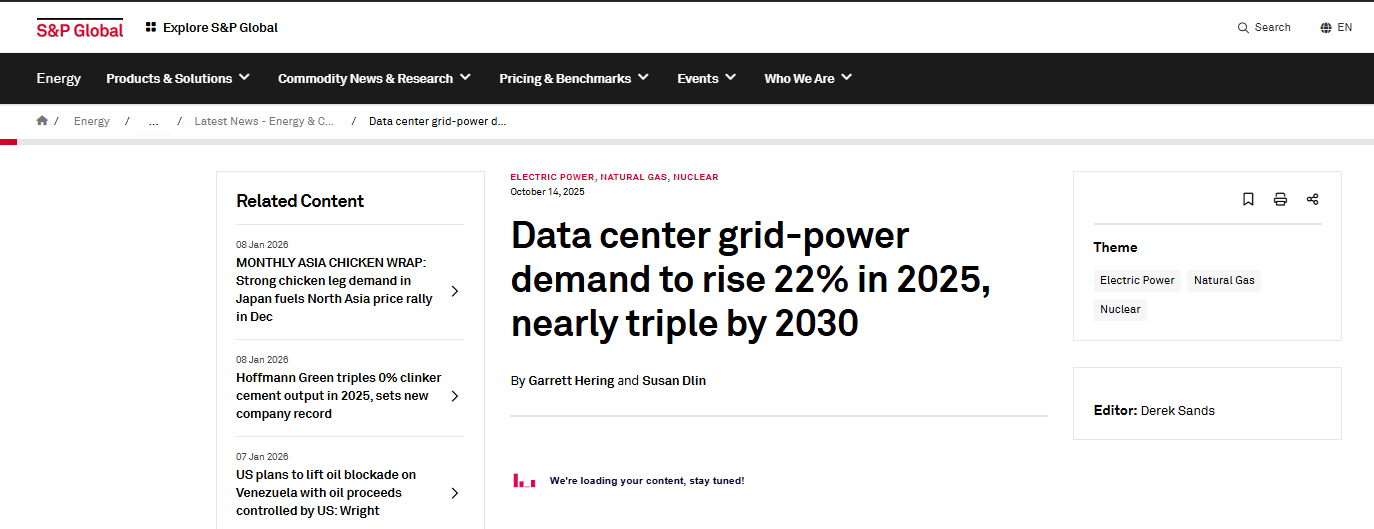
Source: S&P Global.
2. Real-World Example
Electrical contractors are rejecting work because demand exceeds capacity. Projects are large, contracts are long and clients are desperate.
According to a CSIS report, the U.S. will need around 140,000 more electricians by 2030 just to keep up with AI infrastructure. Utilities are already turning down new data center deals if there’s no guaranteed power, long-term contracts and clear commitments from these desperate hyperscalers.
This is buying solid, boring businesses and riding a once-in-a-generation demand wave.

Source: CSIS.
Learn How to Make AI Work For You!
Transform your AI skills with the AI Fire Academy Premium Plan – FREE for 14 days! Gain instant access to 500+ AI workflows, advanced tutorials, exclusive case studies and unbeatable discounts. No risks, cancel anytime.
Start Your Free Trial Today >>
IV. Tier 1: Chips & Manufacturing (The Supply Chain Play)
Do you know NVIDIA? They make the chips (GPUs) that AI needs to “breathe”. It has now become one of the most valuable companies on earth, which controls roughly 92% of the GPU market in 2025.

Source: Carbon Credits.
And NVIDIA does not do it alone. Behind every AI chip is a massive industrial machine: Semiconductors require specialized equipment, ultra-clean facilities, precision parts, constant testing and complex global logistics.
It’s one of the hardest manufacturing processes on earth.
1. Why Direct Chip Manufacturing Is Not Your Play
Unless you have billions in capital and deep technical talent, chip manufacturing isn’t realistic. The capital requirements are insane.
Fabs cost absurd amounts to build, take years to ramp up and face ruthless competition.
2. Where Accessible Opportunities Live
The money often shows up around the factories, not inside them. Instead of trying to make chips yourself, you serve the companies that do:
-
Cleanroom Construction: Building the ultra-clean rooms where chips are made.
-
Logistics: Moving delicate equipment from A to B.
-
Quality Assurance: Testing parts before they go into the machine.
These are boring B2B services on paper but the fabs literally can’t operate without them.

They are less sexy than NVIDIA’s stock price but they are making steady, predictable money.
V. Tier 2: Data Centers & Blue-Collar Gold (The Real Sweet Spot)
This is the most accessible tier for most people. It’s the biggest opportunity if you’re a normal person who doesn’t want to learn Python but still wants a serious income from AI.
AI does not live in “the cloud.” It lives in massive, hot, noisy warehouses called data centers. These data centers are physical buildings that need:
-
Constant cooling.
-
Massive power supplies.
-
24/7 maintenance.
-
Security.
-
Construction and build-out.
And they are being built everywhere, right now.
1. HVAC & Cooling Systems: The Silent Moneymaker
AI servers generate insane heat. If the cooling fails for ten minutes, millions of dollars in hardware melt. So, data centers need industrial-scale cooling that runs nonstop.
HVAC companies servicing data centers are currently printing money. This is a trade-based business with a massive moat because the stakes are so high.
If you have HVAC training, this is your moment. If you own an HVAC business, pivot toward data center work immediately.
2. Electrical Installation & Maintenance: The Foundation Trade
Data centers rely on redundant power, backup generators, high-voltage systems and complex distribution lines. Standard electricians usually cannot do this work; it requires specialized contractors.
These teams are fully booked, hiring fast and getting paid well. Of course, it’s high risk and high responsibility that’s exactly why the pay is so strong. One electrical mistake can shut down millions of dollars of servers. That is why this trade is exploding.
3. Facilities & Cleaning: Boring Work, Locked-In Contracts
Once built, data centers need constant upkeep. Everything inside must be maintained: plumbing, electrical systems, cooling units, air filters, cable rooms, loading bays,… Yes, even cleaning. Dust is a serious issue; it can destroy servers.
Facilities management companies are landing long-term contracts to keep these sites running. The work looks boring from the outside but the revenue is the kind most service businesses dream of having.
A good example here is Promera (formerly Data Clean). They started out just cleaning data centers and clean rooms.
Now they dominate data center cleaning and maintenance for electrical infrastructure in hyperscale facilities (with over 250 technicians and more than 100+ million square feet serviced in 18 months), helping keep AI and cloud giants online while everyone else complains about electrician shortages.

3. Construction & Build-Out: The Physical Backbone
Every data center is a giant construction project. Companies that specialize in these builds have more work than they can handle. The jobs include:
-
Structural construction.
-
Raised floor installation.
-
Cable management systems.
-
Fire suppression systems.
-
Physical security installations.
These projects often run for years and involve hundreds of workers. As long as AI demand keeps rising, this construction cycle will not stop. It’s one of the most reliable streams of commercial construction work today.
Turner Construction Company’s revenue jumped 43% compared to the same period last year, hitting over $21 billion in just the first nine months.
The AI boom has overloaded their pipeline with hyperscale data center projects and they’ve had to pick their winners from a long backlog.

4. Site Preparation & Civil Engineering: The Ground-Level Play
Before the first server arrives, land needs to be cleared, foundations poured and utilities connected. These contracts are massive because data centers require heavy groundwork and extremely stable foundations.
If you work in civil engineering, this is one of the biggest infrastructure booms you’ll see in your lifetime.
5. The Blue-Collar Advantage
Here’s the beauty of this entire tier: you do not need a computer science degree. You need skills like:
-
Commercial driving licenses
-
HVAC certification
-
Electrical licenses
-
Welding expertise
-
Construction experience
These are trades. Real, practical skills that take months to learn, not years. And right now, they are worth more than many tech jobs.
While coding bootcamp graduates fight over entry-level roles, skilled tradespeople are earning five figures installing cooling systems in the AI economy. And the market still can’t get enough of them.
There is a massive shortage of these workers. The demand is only growing.
If you want a simple, no-fluff action plan, I put together a full 90-day roadmap to move into Tier 2 (data centers) here.
VI. Tier 3: Foundation Models (The Billionaire’s Playground)
This tier is simple to explain: You cannot play here.
This is the world where GPT, Gemini, Claude and other foundation models are built. It looks glamorous from the outside but here’s the truth behind the curtain. To even step into this arena, you need:
-
Billions in capital.
-
Thousands of top-tier GPUs (which are already sold out).
-
A small army of PhD researchers.
-
Hardened data centers built like fortresses.
Here’s one story that shows how brutal this tier really is. Elizabeth Yin, Co-founder and General Partner at Hustle Fund, said she is seeing Series A AI companies burn around $500,000 per month on GPUs while showing zero profit margin. When I read that, I just thought: this game is not for normal people.
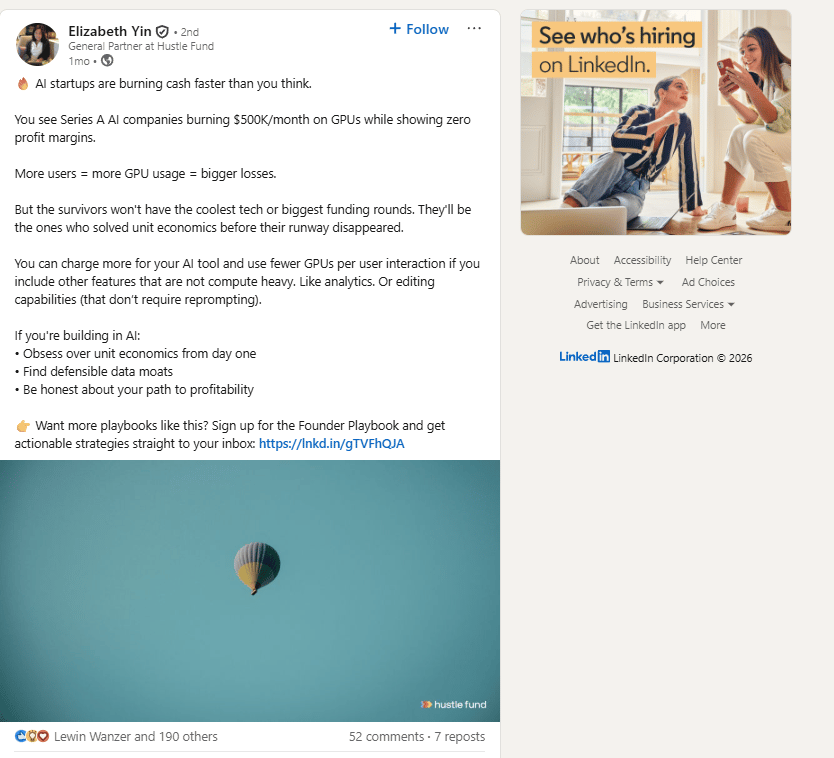
Source: LinkedIn.
Even if you had the money, you literally cannot get the GPUs. NVIDIA has a waiting list. Most of the supply goes straight to Google, Microsoft, Meta, OpenAI and a few other giants who buy chips by the tens of thousands.
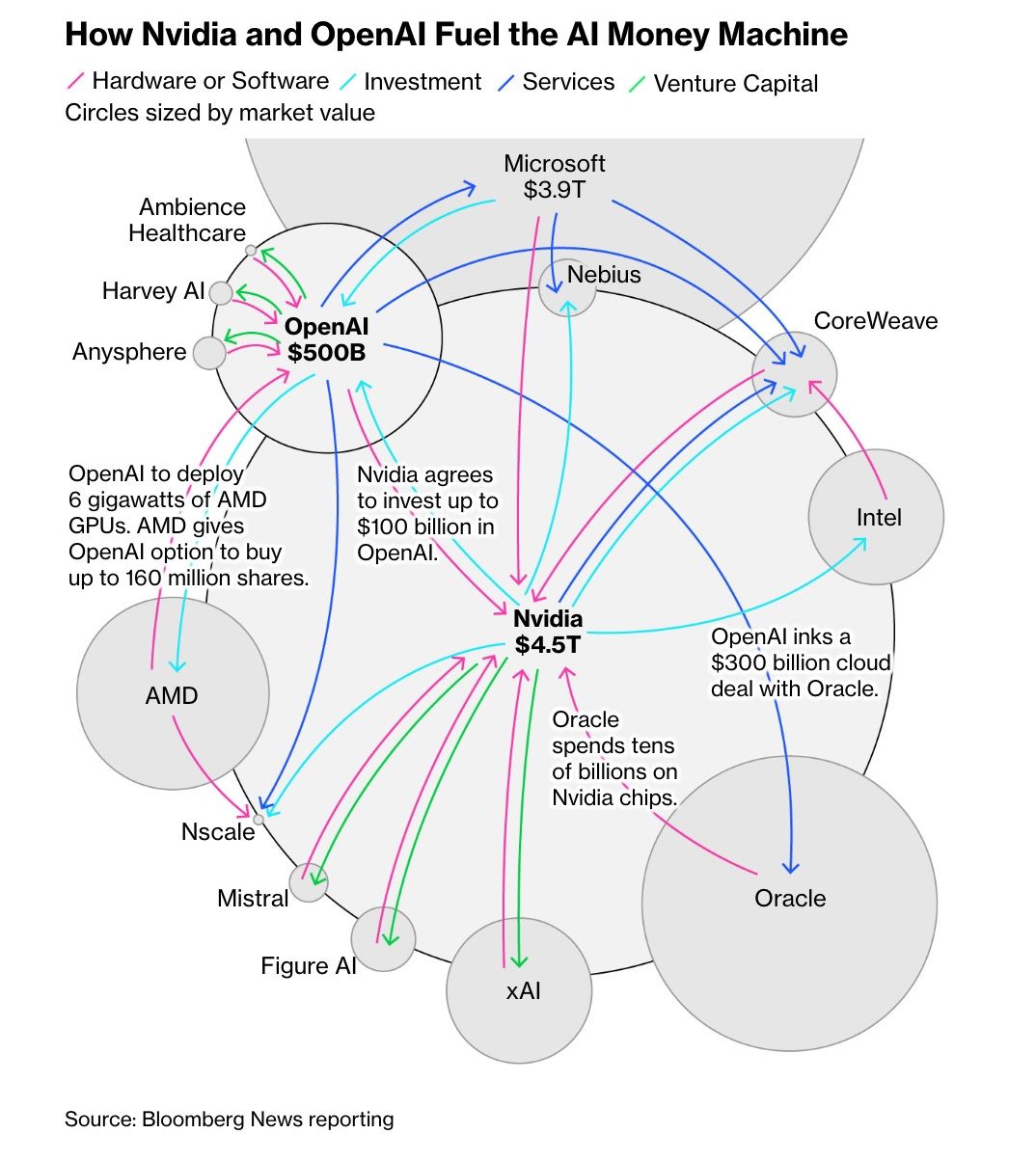
Look at the chart below. Did you see something? Of course, the answer is that all the big companies are “sleeping” with each other.
And this is called circular financing, which basically means that money flows in a loop between these companies instead of coming from normal customers. And do you think you can be a part of it? No freaking way!
Source: Bloomberg News.
They’re playing a different game that you cannot access, no matter how smart, determined or ambitious you are. And that’s fine.
Because the real opportunity sits outside this locked room in all the layers that depend on these models, not in the models themselves. That’s where regular people can win.
VII. Tier 4: Orchestration & Tools (The Technical Middle Ground)
This is the layer where people take raw AI models and turn them into tools that businesses can actually use. Not the flashy headline stuff but the essential, behind-the-scenes machinery that keeps everything running.
1. What Lives Here
Inside this tier, you’ll find the quiet workhorses: vector databases for AI data storage, integration platforms connecting AI to existing business systems, workflow automation tools, prompt engineering solutions, security and compliance frameworks,…
This is where companies like LangChain, n8n, Zapier,… live here. They are not building the AI brain itself but building the skeleton and wiring that lets the brain do something useful.

2. The Opportunity for Technical Founders
If you can code and you understand how real businesses operate, this tier opens a door. Most companies have no idea how to bring AI into their workflows. So all they need is a person who can:
-
Install AI into old processes.
-
Build internal tools around it.
-
Manage data, permissions and guardrails.
-
Make sure everything plays nicely with their existing systems.
This is classic B2B software, which typically has higher margins, longer contracts and customers who will happily pay for stability.
3. The Challenge
But this tier has a catch. This space moves incredibly fast. By the time you build something, three competitors and a free open-source alternative might exist. You need to move quickly and solve specific, painful problems.
To see how tight this competition already is, just take one tiny example. Now, I want you to open YouTube and search “n8n AI Assistant.” You see how crazy competitors are, right? There are so many videos and people have created videos about it.
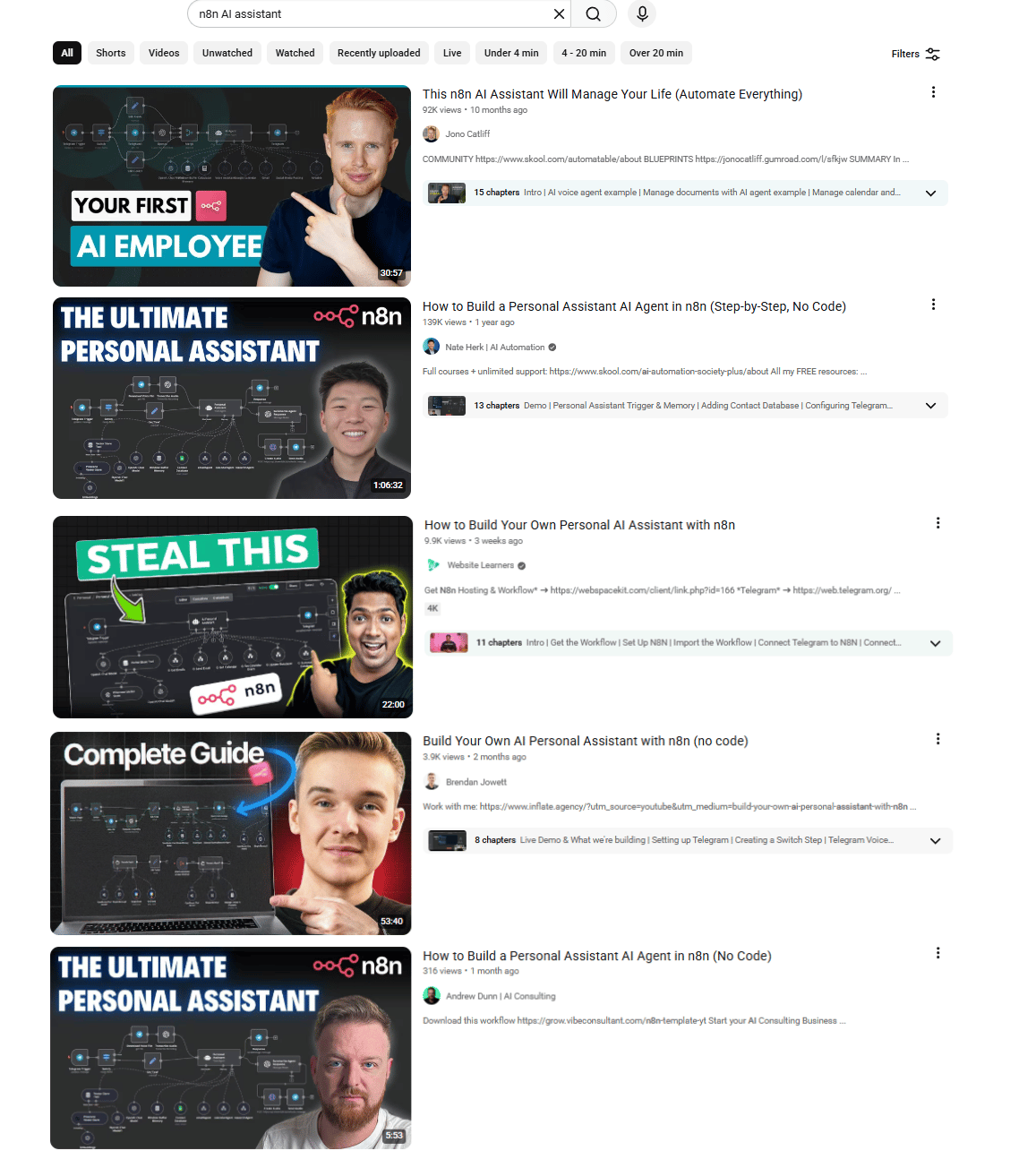
This tier isn’t easy. Success here requires you to have technical skill plus a deep understanding of a particular industry vertical.
VIII. Tier 5: AI Applications (The Overcrowded Penthouse)
Finally, the last tier. This is the “penthouse” where 99% of people are trying to build. It is also where 99% of people will fail.
This is the place where the AI apps live: the writing tools, the image generators, the productivity dashboards, the “ChatGPT but with a nicer UI” startups, the industry-specific assistants.
1. Why Most AI Apps Will Not Survive
The first thing you notice when you walk around this penthouse is how similar everything looks. Everyone is building the same thing with the same ingredients.
Then you see why the room keeps emptying.
-
Commoditization hits like a hammer: Features that look new today often become a standard part of ChatGPT tomorrow. Remember when AI transcription was a paid service? Then OpenAI released Whisper for free and wiped out half the market overnight.
-
Most apps have zero moat and nothing unique behind the scenes. They’re just “wrappers” around ChatGPT. They take OpenAI’s brain, give it a different skin and charge $29 a month. So, why would someone pay $29/month for your app when they can easily replicate it for free with ChatGPT?
-
Marketing becomes the real battle: Standing out in an ocean of AI tools requires massive marketing spend. Without a giant ad budget or a massive audience, most apps drown before they even get noticed.

Whisper AI: An advanced, free, open-source automatic speech recognition system.
2. The Rare Exceptions That Might Work
But if you keep walking through the room, you’ll find a few companies that look calm. They’re not fighting the crowd or trying to be everything for everyone. They just build differently.
-
They build for a tiny, specific niche: Generic AI tools are dead. But “AI specifically for orthodontists analyzing X-rays and predicting treatment timelines” has potential.
-
They own distribution: If you already have an audience, customer base or sales channel, you can build AI tools specifically for them.
-
They combine AI with something unique: Vertical integration creates defensibility. If you are training models on proprietary data sets or combining AI with specialized human services, you might survive.
-
And above everything else, they move fast: Speed is your only advantage. You have to launch, learn, pivot and repeat it faster than the big companies can react.
Creating quality AI content takes serious research time ☕️ Your coffee fund helps me read whitepapers, test new tools and interview experts so you get the real story. Skip the fluff – get insights that help you understand what’s actually happening in AI. Support quality over quantity here!
3. The Harsh Reality
Trying to build a stable AI app business in 2026 is hard mode. It’s not impossible but you are fighting uphill against tech giants, market saturation and rapid feature commoditization.
If you choose this path, walk in with clear eyes. The penthouse looks beautiful but survival here requires speed, precision and a niche so specific that nobody else bothers to fight you for it.
IX. Where Should Smart Money Go If You’re a Normal Person?
Tier 2 first (data centers), Tier 0 second (energy), Tier 4 if you’re technical. These tiers have real constraints, real budgets and less hype-chasing competition. They’re built on demand, which keeps rising.
Key takeaways
-
Tier 2 = most accessible + durable
-
Tier 0 = slow, steady compounding
-
Tier 4 = technical leverage with focus
The best opportunities are usually the ones that people are not bragging about on social media.
After analyzing all six tiers, here is where normal people should focus based on accessibility, sustainability and profit potential.
1. Best for Most People: Tier 2 (Data Centers)
This is the road that almost nobody talks about, yet it’s the one packed with real, durable opportunity. This tier wins because:
-
Physical businesses are hard to copy.
-
Skilled trades are in severe shortage.
-
Contracts run for years, not months.
-
No AI update can suddenly destroy your company.
This is the kind of work that doesn’t disappear when the hype cycle moves on.
You don’t need a startup pitch deck to enter this space. You either learn a high-demand trade like electrical work, HVAC or welding or you hire people who already have those skills. Then you buy or partner with an existing service business and slowly shift its focus toward data centers.
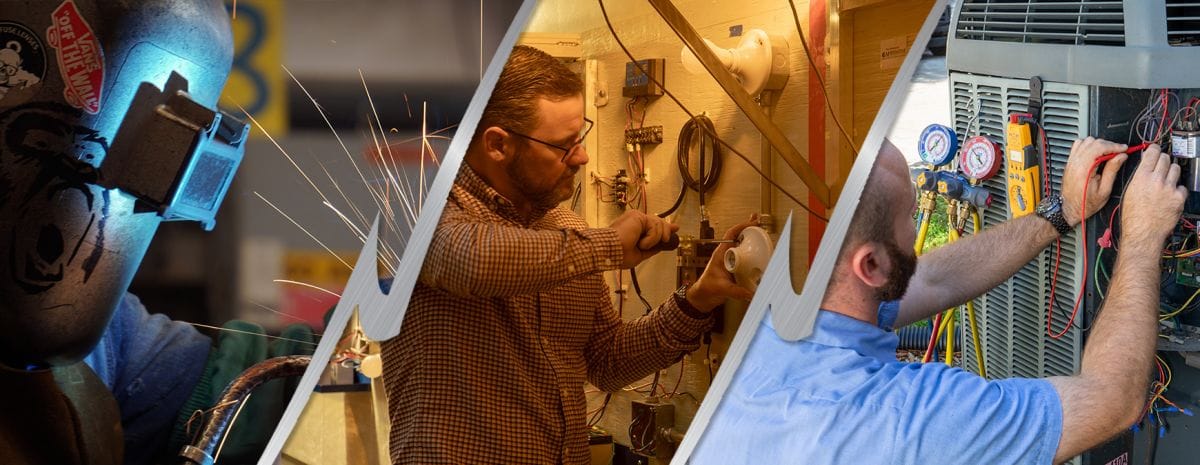
Next, you build trust with developers and operators who care about reliability, not flashy ideas. Some even win by supplying skilled workers where demand is highest.
2. Strong Long-Term Play: Tier 0 (Energy Infrastructure)
If Tier 2 is the default, energy infrastructure is the patient play.
Every AI system depends on power. That demand keeps rising regardless of which model wins. Governments are pouring money into grid upgrades, storage and resilience. These are established businesses with boring names and proven economics, which is exactly why they endure.
This path often starts with acquiring or investing in small electrical or energy-related companies. Others partner with renewable energy providers that target data center demand directly. Some focus on storage and backup systems that become more valuable as grids strain under load.
This path grows slowly but never stops growing.

3. For Technical People: Tier 4 (Orchestration Tools)
If you’re technical and you like solving messy business problems, Tier 4 is where you should aim.
Most companies don’t want “AI.” They want solutions to specific problems: compliance, data management, workflow integration and security. Tools that help them connect AI to messy legacy systems quietly create value without chasing consumer attention.
Success here comes from focus. You pick an industry, learn its pain points and build or implement tools that save time, reduce risk or unlock new capabilities. Many who succeed don’t even sell software at first. They sell services, then turn repeated solutions into products.
It’s slower than consumer apps but far more stable.

4. High Risk Territory: Tier 5 (AI Apps)
This is the tier everyone wants to talk about. It’s also where most people SHOULD NOT play.
You only step into this space if you already have distribution, a loyal audience or a locked-in customer base. You must solve a problem so specific that no general tool bothers to touch it.
And you need to move fast, faster than competitors, faster than platforms, faster than feature releases.
Even then, failure is common. For most people, the smart move is to admire this tier from a distance and focus energy elsewhere.
The smartest money in the AI economy doesn’t chase the penthouse. It chooses the path with the highest odds of long-term success. Tier 2 and Tier 0 carry the most durable opportunities. Tier 4 works for technical builders. Tier 5 is for the brave.
Choose the road that fits your skills and your risk tolerance, not the road with the loudest crowd.
X. What Does Sell Picks and Shovels Mean in The AI Boom?
It means you profit from the boom without betting on which app wins. You sell the essentials: power, cooling, maintenance, compliance and infrastructure. When everyone needs the same backbone, backbone businesses compound.
Key takeaways
-
Avoid hype dependency.
-
Sell to many “miners”.
-
Durability > trend.
Apps come and go but the infrastructure stays.
Every gold rush ends the same way. Most miners leave with empty hands and the people who sell tools walk away rich.
In 1849, prospectors chased gold across California. Levi Strauss sold jeans to miners and built a company that still exists 175 years later.
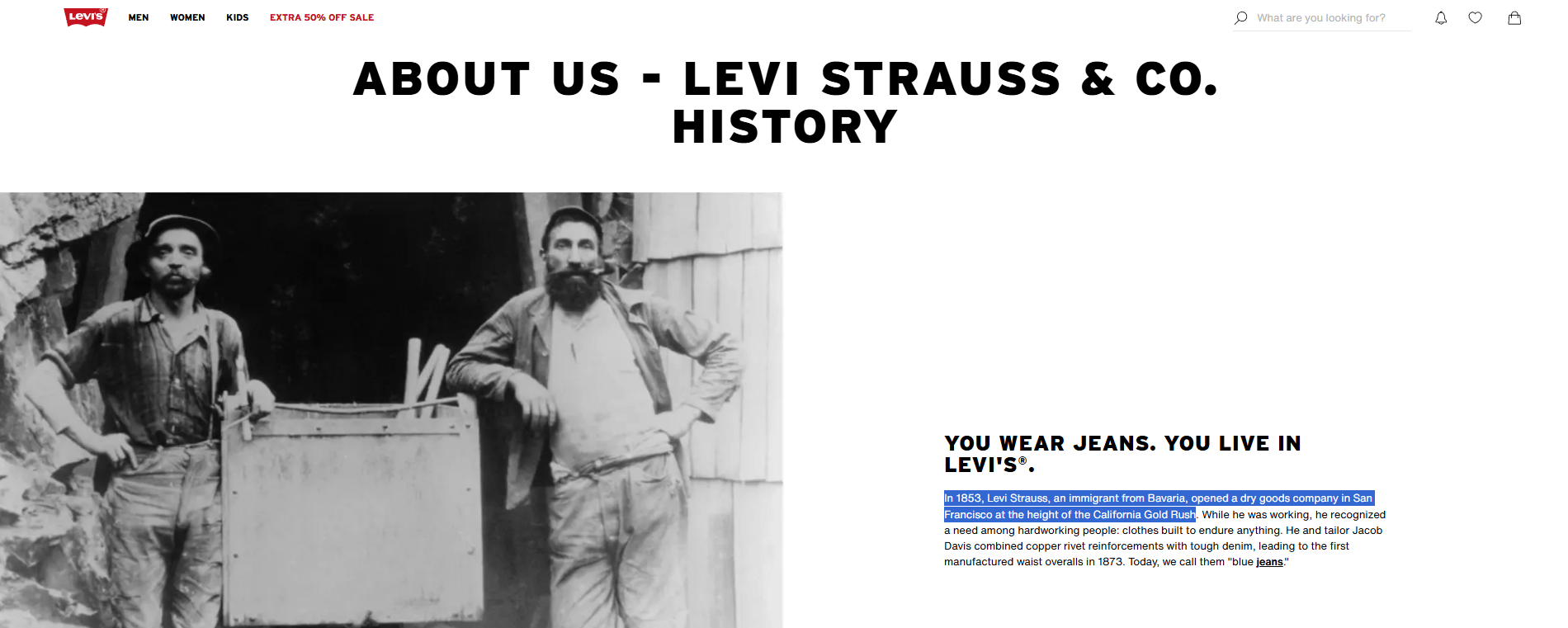
The AI boom is the same. While everyone fights to build the next viral AI app, the real money is flowing into the boring stuff: data centers, power upgrades, cooling systems, chip support and energy generation.
This is physical work. It can’t be copied or disrupted overnight. And right now, it pays.
XI. Conclusion: Boring Infrastructure Beats Flashy Apps
The real money in the AI economy isn’t in the AI itself. It is in the foundation, the plumbing and the power.
While the tech bros are arguing on X about which chatbot is smarter, the electrical contractor who signs a long-term deal with a server farm is the one building real wealth.
So while everyone else chases the AI app dream, maybe it is time to pick up a wrench and build the systems that AI actually needs. Your bank account will thank you.
If you are interested in other topics and how AI is transforming different aspects of our lives or even in making money using AI with more detailed, step-by-step guidance, you can find our other articles here:
-
How to Attract High-Value Clients in 2026 with Just One Clear Positioning Move*
-
I Built A Bitcoin Bot With Gemini 3: These Results Will Shock You*
-
Proven Zero-Guessing Framework to Build What People Will Actually Pay For
-
The $1M/Year AI Automation Blueprint (From A 23-Year-Old)
*indicates a premium content, if any
Leave a Reply