

This guide reveals 10 advanced rules (like “Power Phrases” and “Scaffolding”) to transform Claude from a basic tool into your powerful, strategic partner.. Llms (Large Language Models), Prompt Engineering, Ai Fire 101.
TL;DR BOX
Anthropic’s 10 rules for “10x-ing” Claude’s performance transform Opus 4.5 from a generic chatbot into a strategic partner by emphasising clear context, constraints and structured prompting. Users must stop using vague “magic 8-ball” commands and instead provide detailed instructions like tone, audience and format.
The core strategy involves breaking complex tasks into steps (“Divide & Conquer”), requesting structured outputs like tables and using “power phrases” like “think step-by-step” to guide Claude in solving tougher problems. By adopting specific personas and providing “scaffold” templates, users can eliminate generic “AI slop” and generate expert-level content instantly with Opus 4.5.
Key points
-
Fact: Using “action verbs” like “critique”, “compare” and “analyze” forces Claude into specific operational modes for better results.
-
Mistake: Asking for a perfect final draft immediately; instead, request an outline first to “course-correct” early.
-
Action: Use the “Persona” rule by prompting Claude to “Act as a [specific expert]” to unlock domain-specific vocabulary and depth.
Critical insight
Creativity thrives on boundaries; giving Claude strict constraints (e.g., “do not use the word ‘cyber’”) forces higher-quality, less generic creative decisions.
Table of Contents
I. Introduction: The “Magic 8-Ball” Problem
So, you’ve been chatting with Claude like it’s a magic 8-ball, typing “write me a blog post” and wondering why the output feels like robotic fluff?
Yeah, I’ve been there too.
Here’s the thing: Claude (and its bigger brother, Opus 4.5) isn’t bad at what it does. The problem is, you’re not using it the right way. It’s like going to a restaurant, pointing at the menu and saying, “Food, please”. You’ll get something but it won’t be special.
I just recently found 10 rules from Anthropic that are far more useful than most of the prompt guides floating around on X or the internet. These aren’t generic tips like “be more specific.”
They are practical ways to help you work with Claude as a real thinking partner, not just a basic text tool. Keep these rules close; you’ll come back to them more than you expect.
We’re talking about going from a basic Wikipedia-style summary to a finished, high-quality piece that sounds like you wrote it on your best day.
*Before we get into the first rule, I need to confess. At the last of each rule, I already created an image that summary all the context of that rule for you to save it easily on your phone. In case you want to create the same images like that, this previous post is for you.
Okay, let’s get started.
II. Rule #1: The Tone of Collaboration (Stop Being Weird)
Here’s the truth: if you’ve been asking Claude to do your bidding like you’re walking on eggshells, you’re part of the problem. You’re either being way too polite or barking orders like a dictator. Guess what? Neither of those works.
Claude Opus 4.5 doesn’t need you to be super polite or overly bossy. It just needs you to talk to it like it’s a teammate. Be clear and direct but friendly.
Stop saying: “Fix this grammar. NOW!”
Instead, try:
Please review this for grammatical errors and suggest ways to make it sound more professional and confident.
Don’t believe me? Think of it like this: If you walked into your coworker’s office and shouted, “MAKE IT BETTER,” would you expect them to do their best work? Probably not.

III. Rule #2: The Principle of Explicitness (Details Are Your Superpower)
Let’s be real here: Claude Opus 4.5 isn’t magic. It doesn’t know what’s in your head. If you expect it to just figure things out for you, you’re going to be disappointed.
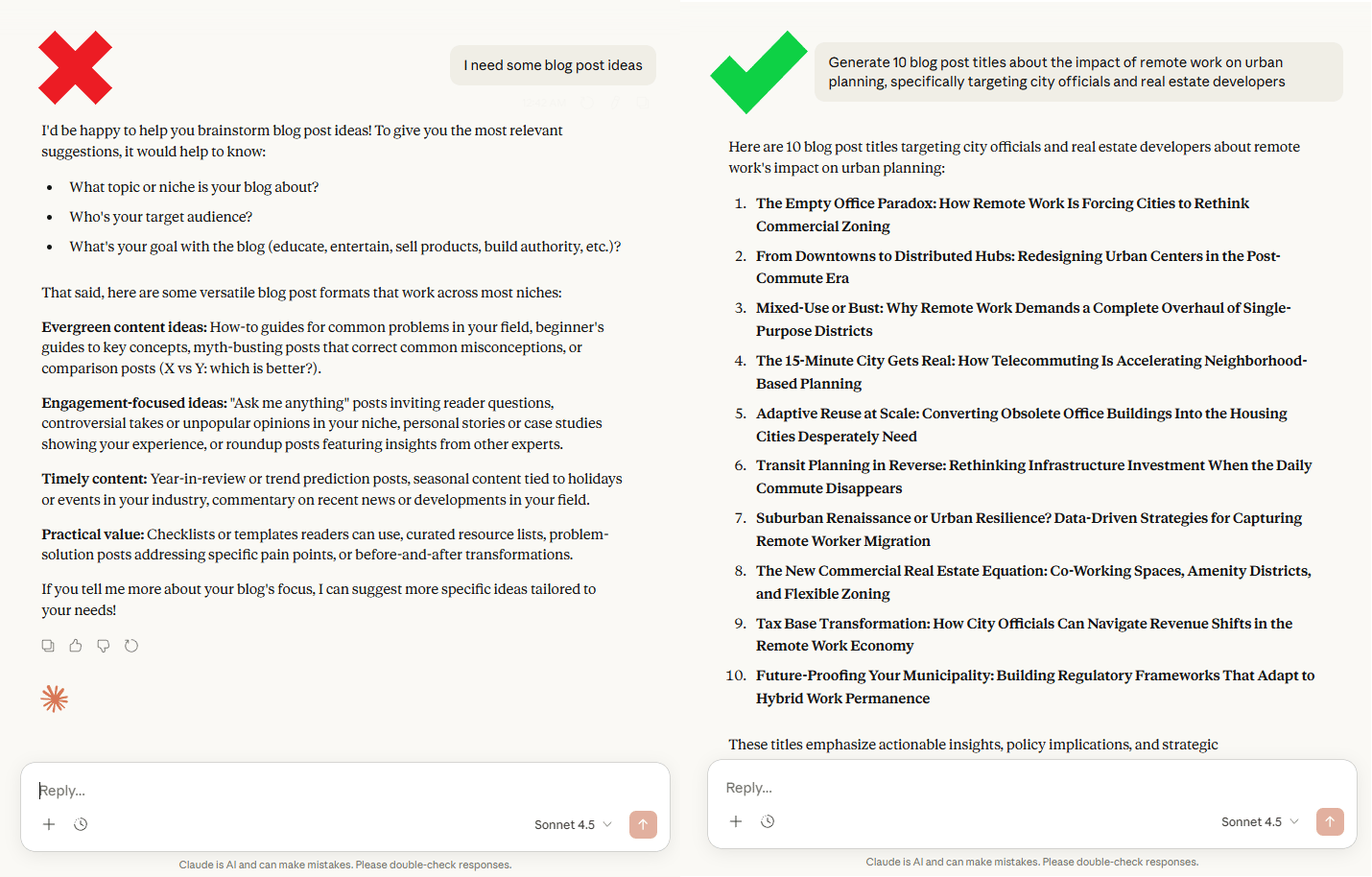
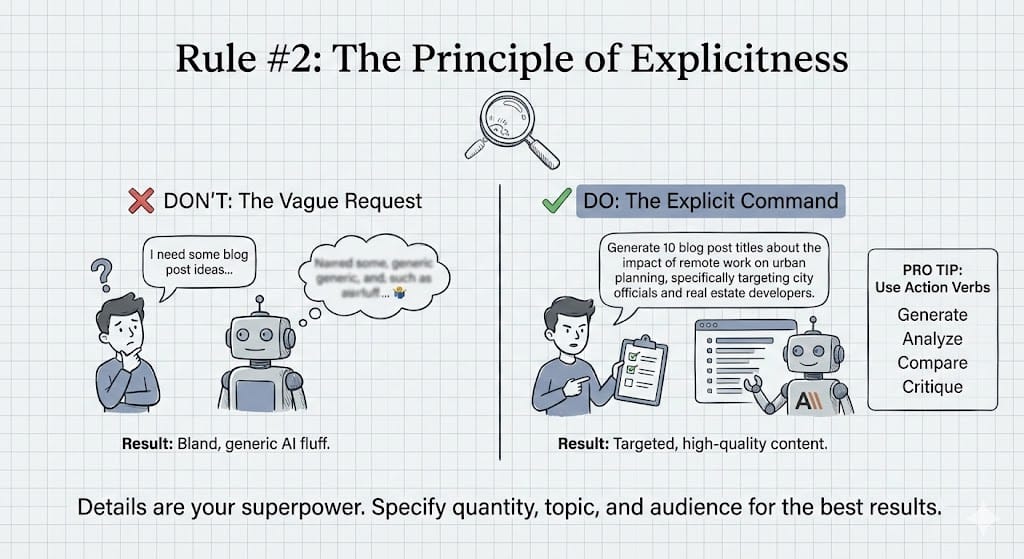
If you don’t specify, you’ll get bland, generic answers. So, be clear and precise. Tell Claude exactly what you want, like how many things you need, the topic and who you’re writing for. You need to treat Claude like an assistant; you tell it what to do, not the other way around.
Don’t ask for “some blog post ideas.”
Instead, say:
Generate 10 blog post titles about the impact of remote work on urban planning, specifically targeting officials and real estate developers.Get it? When you tell Claude exactly what you want (quantity, topic and audience), it has no choice but to give you what you need. But if you leave it up to guesswork, you’ll get the usual AI fluff.
Use action verbs. This is my top tip for better results. They tell Claude exactly what mode to operate in. Action words like “generate”, “analyze”, “compare” and “critique” work wonders.
Learn How to Make AI Work For You!
Transform your AI skills with the AI Fire Academy Premium Plan – FREE for 14 days! Gain instant access to 500+ AI workflows, advanced tutorials, exclusive case studies and unbeatable discounts. No risks, cancel anytime.
Start Your Free Trial Today >>
IV. Rule #3: Define the Boundaries (Creativity Loves Constraints)
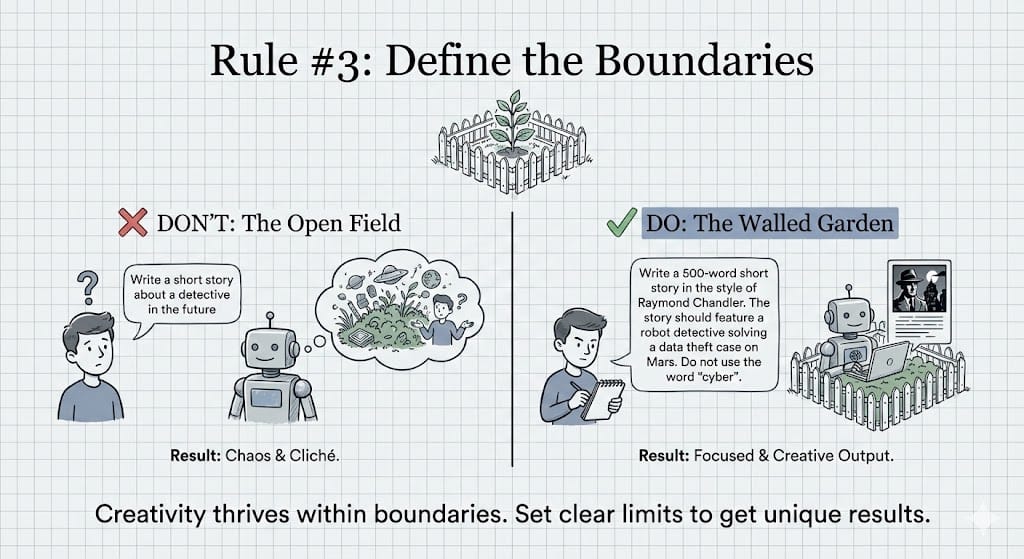
You want to know the real secret? Constraints are your friend. You’ve been told that “creativity has no limits,” but that’s a lie. The best ideas come when you set clear boundaries and force yourself to work within them.
When you give Claude Opus 4.5 an open-ended request, it gets lost with no structure equals confusion. It’s like putting a fence around a garden; without it, everything gets messy.
Instead of saying: “Write a short story about a detective in the future,”
You could try:
Write a 500-word short story in the style of Raymond Chandler. The story should feature a robot detective solving a data theft case on Mars. Do not use the word "cyber".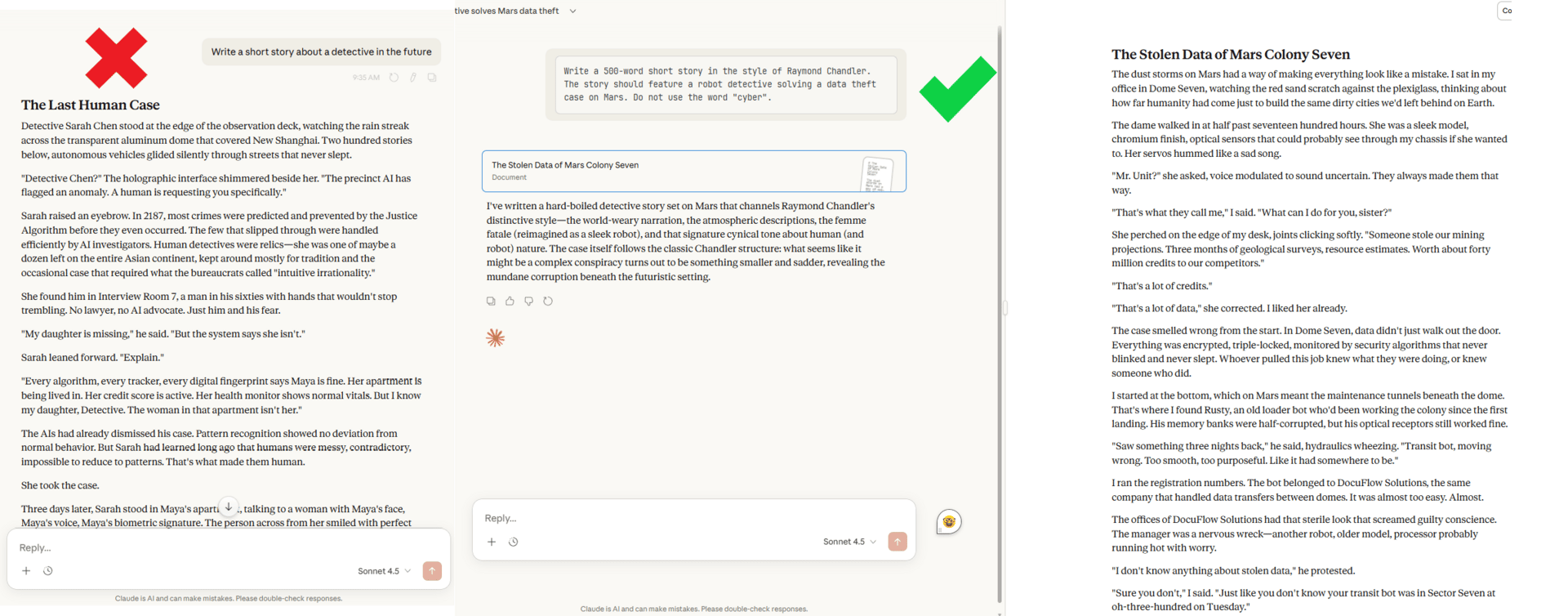
See the difference? With clear instructions, you’re pushing Claude to get specific. You’re limiting its options, forcing it to think harder and make more creative decisions. Creativity thrives within boundaries.
Once you’ve set clear boundaries for Claude, the next step is to ask for an outline before diving into a full draft. This keeps the process manageable and ensures you can course-correct early.
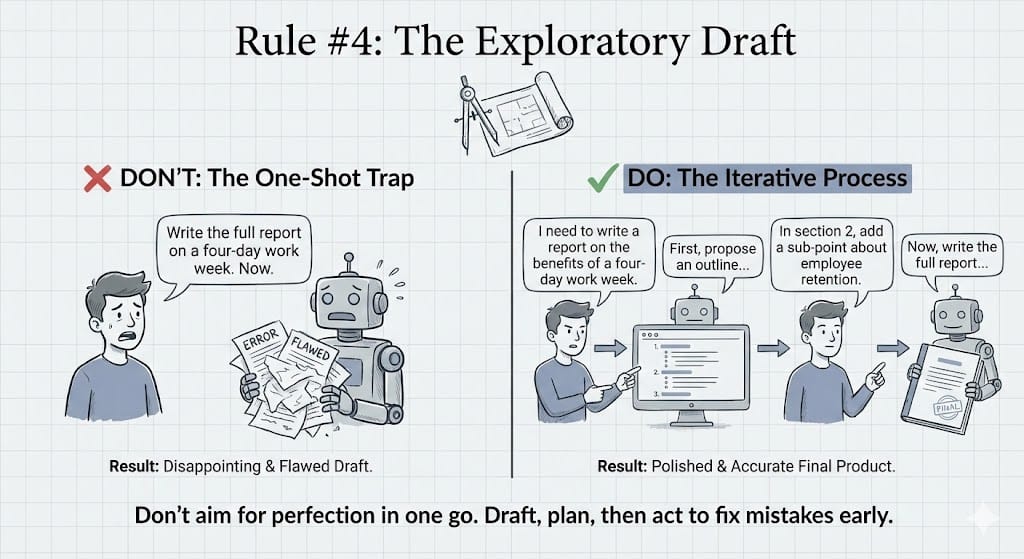
V. Rule #4: The Exploratory Draft (Stop Asking for Perfection in One Shot)
Perfection is a trap. You’re probably trying to get Claude Opus 4.5 to give you a perfect result right off the bat. That’s not realistic.
Rather than asking for a finished product in one go, break it down into stages. Ask for an outline first, then refine and finally, get the full thing.
Here’s how:
-
Start with the prompt: “I need to write a report on the benefits of a four-day work week.”
-
Ask for a plan: “First, can you propose an outline for this report?”
-
Refine the plan: “That looks good. In section 2, please add a sub-point about employee retention.”
-
Finally, get the full report: “Great. Now, write the full report based on this revised outline.”

Why this works: This rule lets you fix mistakes early on. You don’t have to hope the first version is perfect. You can fix mistakes as you go.
VI. Rule #5: Demand Structured Output (Tables, Formats, Schemas FTW)
Stop asking for text when you could get something far more useful. Claude defaults to paragraphs but that’s often not the format you need. So, ask if you need a clean, structured format.
Don’t just say: “List the last three Apollo missions and some facts about them.”
You could change by typing:
Provide a list of the last three Apollo missions (15, 16 and 17). For each mission, include the launch date, the crew members and a key scientific achievement. Present this information in a Markdown-formatted table.
With that, you get clean, scannable data instead of a wall of text. Tables, lists and other formats are so much more useful. They’re scannable and ready to be used immediately. And the best part? Claude can output in formats like JSON, CSV and Markdown if you ask. So don’t leave that on the table.

VII. Rule #6: Explain the “Why” (Context Is King)
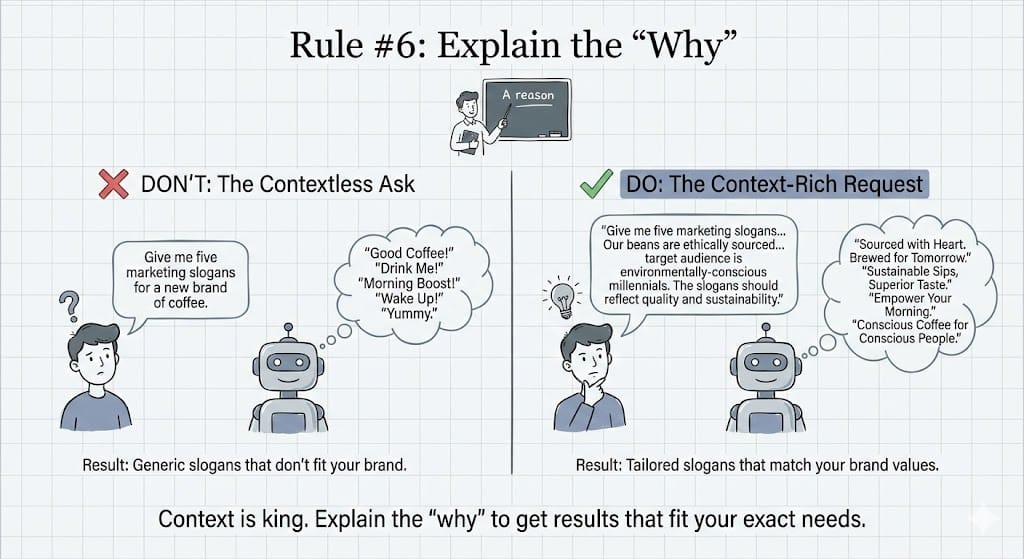
Here is the thing you need to fix: you’ve been asking Claude for results without giving it enough context. Don’t you know that context is everything? It’s the difference between getting something generic and getting something tailored to your exact needs.
Instead of asking something like this: “Give me five marketing slogans for a new brand of coffee,”
You need to explain why you’re asking for:
Give me five marketing slogans for a new brand of coffee. Our beans are ethically sourced from small, independent farms and our target audience is environmentally-conscious millennials. The slogans should reflect quality and sustainability.
Why? Because now Claude has the context it needs to give you something that fits your brand’s values. Without context, you just get random slogans that don’t fit your brand.
Now that you understand the importance of context in getting the best from Claude, it’s time to apply that knowledge. Take this quick quiz to find out which rule you should focus on for your project. Let’s narrow it down.
VIII. Rule #7: Control Brevity vs. Verbosity
Claude has no idea if you want a deep thinking or a quick overview. You have to set the level of detail yourself.
Don’t just say: “Explain photosynthesis.”
Instead of that, you need to be clear. For example, here is what you need to say:
-
You want deep thinking: “Explain photosynthesis in detail for a college biology student. Think step-by-step.”
-
You want a quick summary: “Explain photosynthesis in a few sentences, using bullet points.”
-
You just want simplicity: “Explain photosynthesis like I’m five years old.”
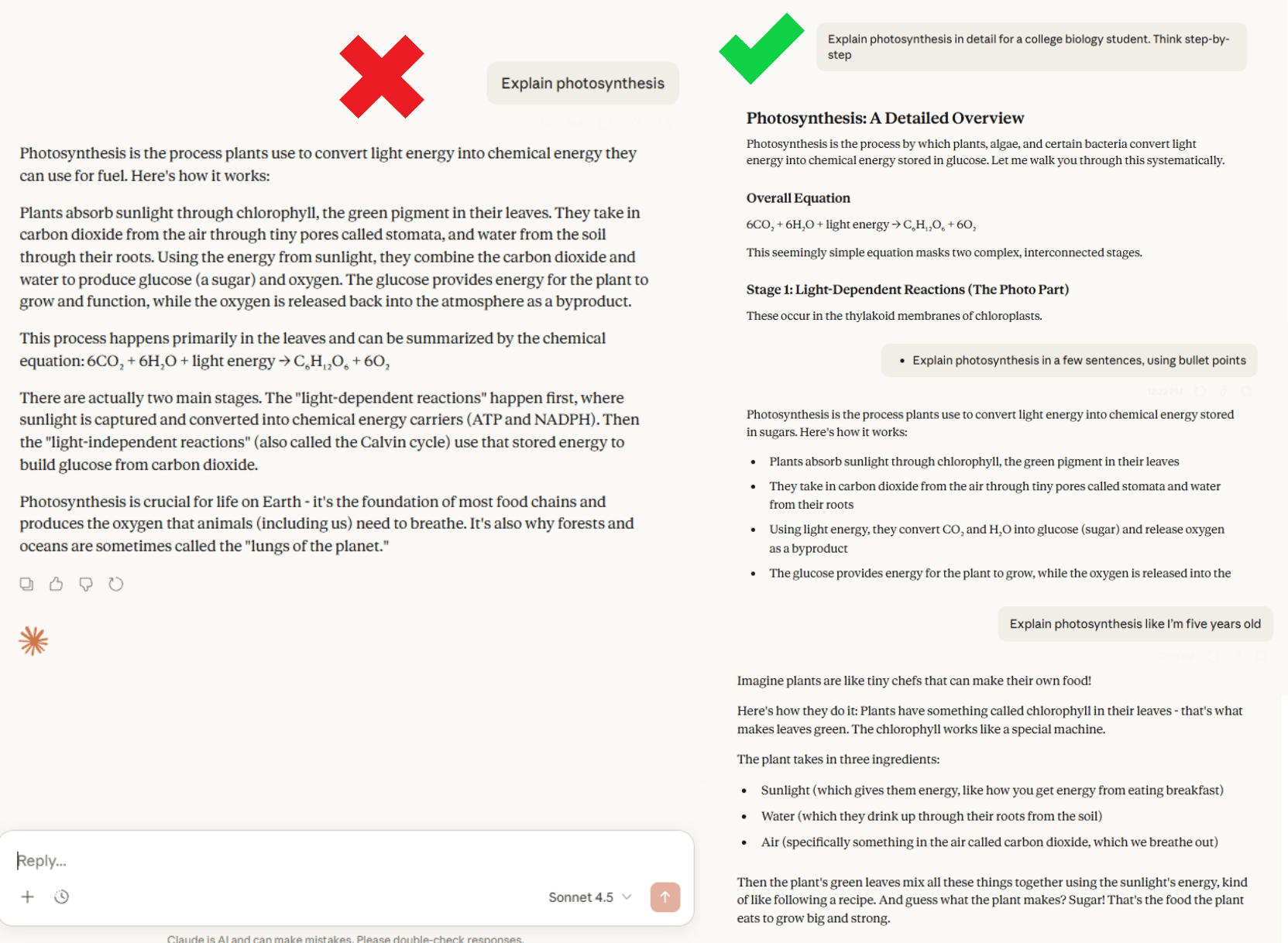
You’re basically telling Claude how much brainpower to use. You can get three different answers for the same topic just by changing the detail level. Setting the level of detail upfront helps you get the exact output you need; nothing more, nothing less.

IX. Rule #8: Provide a Scaffold (Templates Are Your Secret Weapon)
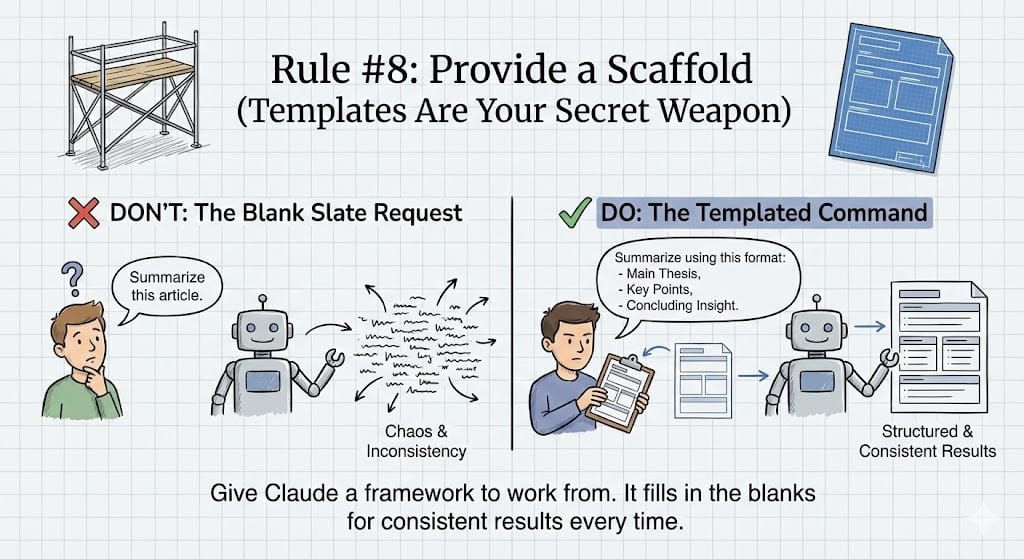
Templates work. Why do I say that? Stop making Claude do the same thing over and over again. You need to give it a template to work from and it’ll save you tons of time.
Usually, you may say: “Summarize this article.”
That move is so amateur and easy to fail. Instead of that, I recommend you try:
Summarize the following article using this format:
- Main Thesis (1 sentence): [AI fills this in]
- Key Supporting Points (3 bullet points): [AI fills this in]
- Concluding Insight (1 sentence): [AI fills this in]

[Paste article text here]
Why does it work? Easy, you’re providing Claude with a framework to work from. It just fills in the blanks. Now you get consistent results every time.
X. Rule #9: Use “Power Phrases” and Expert Personas
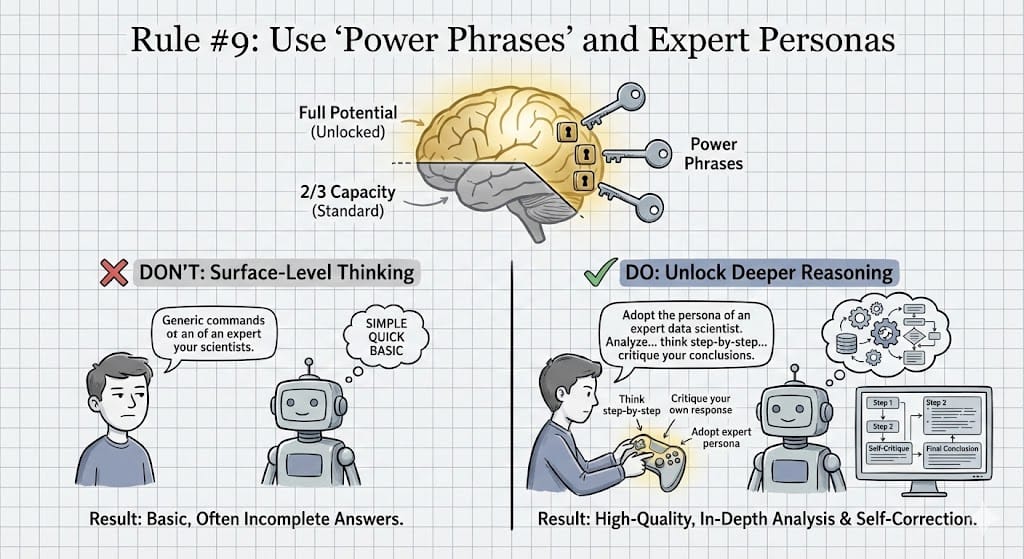
This rule will push your Claude Opus 4.5 to a higher level. Most people only use part of Claude’s power. You can unlock its full potential with the right triggers.
Let me introduce “power phrases”, the thing will help you unlock higher-level reasoning.
Here is the Power Phrase Toolkit you could try immediately:
-
“Think step-by-step”: Forces Claude to show its reasoning process instead of jumping to conclusions.
-
“Critique your own response”: Triggers self-correction and refinement.
-
“Adopt the persona of an expert in [field]”: Primes Claude with domain-specific knowledge and vocabulary.
Do you want something more visually understandable? Let me take this example for you, you could do exactly the same:
Adopt the persona of an expert data scientist. Analyze this dataset and think step-by-step through potential correlations. Then critique your own conclusions and identify any assumptions you've made.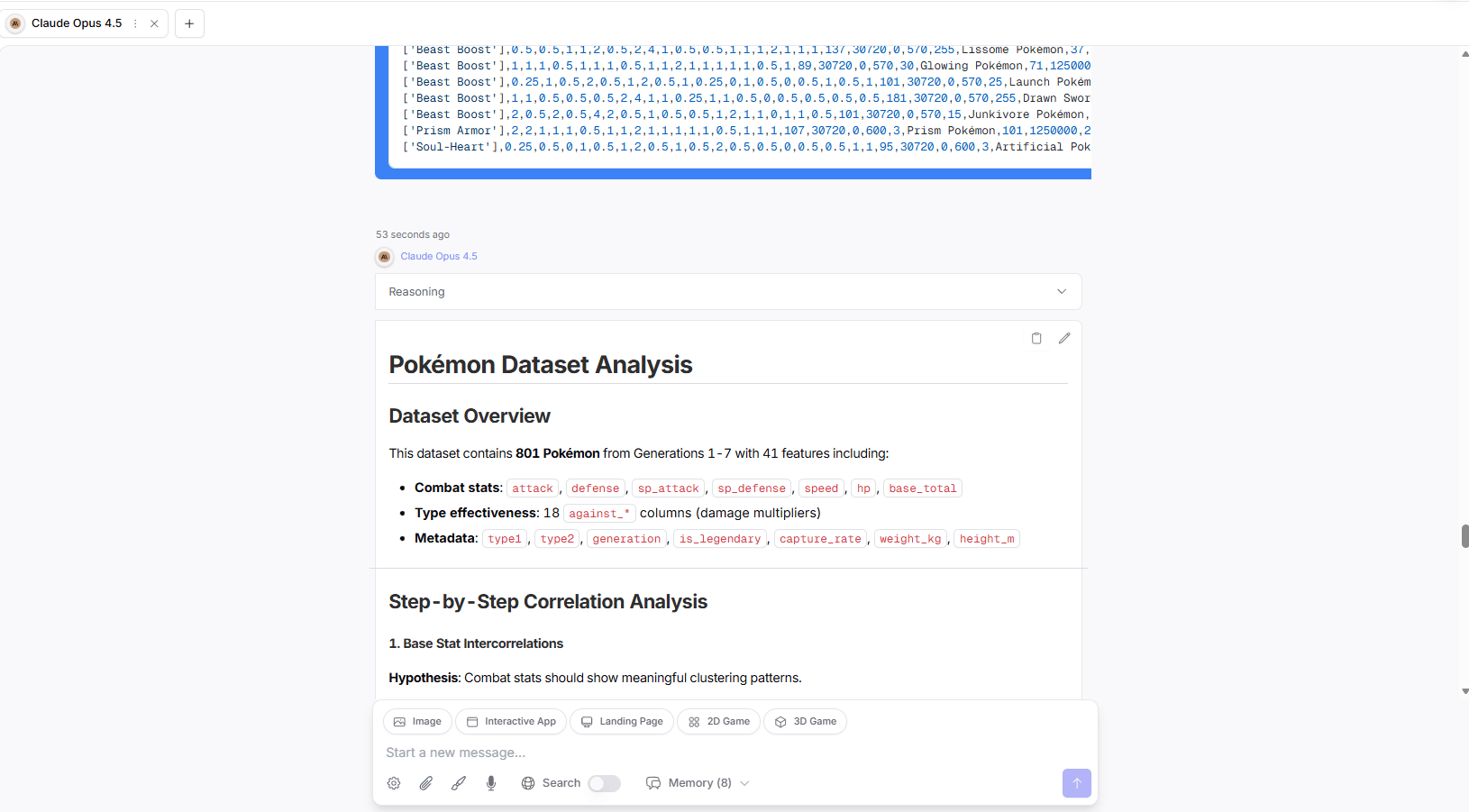
This test was run in OpenRouter – Claude Opus 4.5 model.
These phrases unlock Claude’s deeper reasoning abilities. Instead of giving you surface-level responses, it’ll break down its thinking and critique itself, which leads to better quality.
Creating quality AI content takes serious research time ☕️ Your coffee fund helps me read whitepapers, test new tools and interview experts so you get the real story. Skip the fluff – get insights that help you understand what’s actually happening in AI. Support quality over quantity here!
XI. Rule #10: Divide & Conquer (Act Like a Conductor)
The last rule you want to note is: Claude models (even Opus 4.5) can’t handle complex tasks with a single mega-prompt. It’s overwhelming for both you and it. You’ve got to break tasks down into smaller steps and then bring them together.
Let’s start with a simple prompt:
Create a detailed table of contents for a business plan for a new specialty coffee shop.Then you break it down by prompting for each part separately:
-
“Write the Executive Summary based on our plan.”
-
“Now, write the Market Analysis section.”
-
…
Finally, you prompt for the synthesis to have the complete business plan:
Review the complete business plan. Ensure consistency in tone and check for contradictions.By tackling tasks in smaller chunks, you maintain control and quality throughout the process.
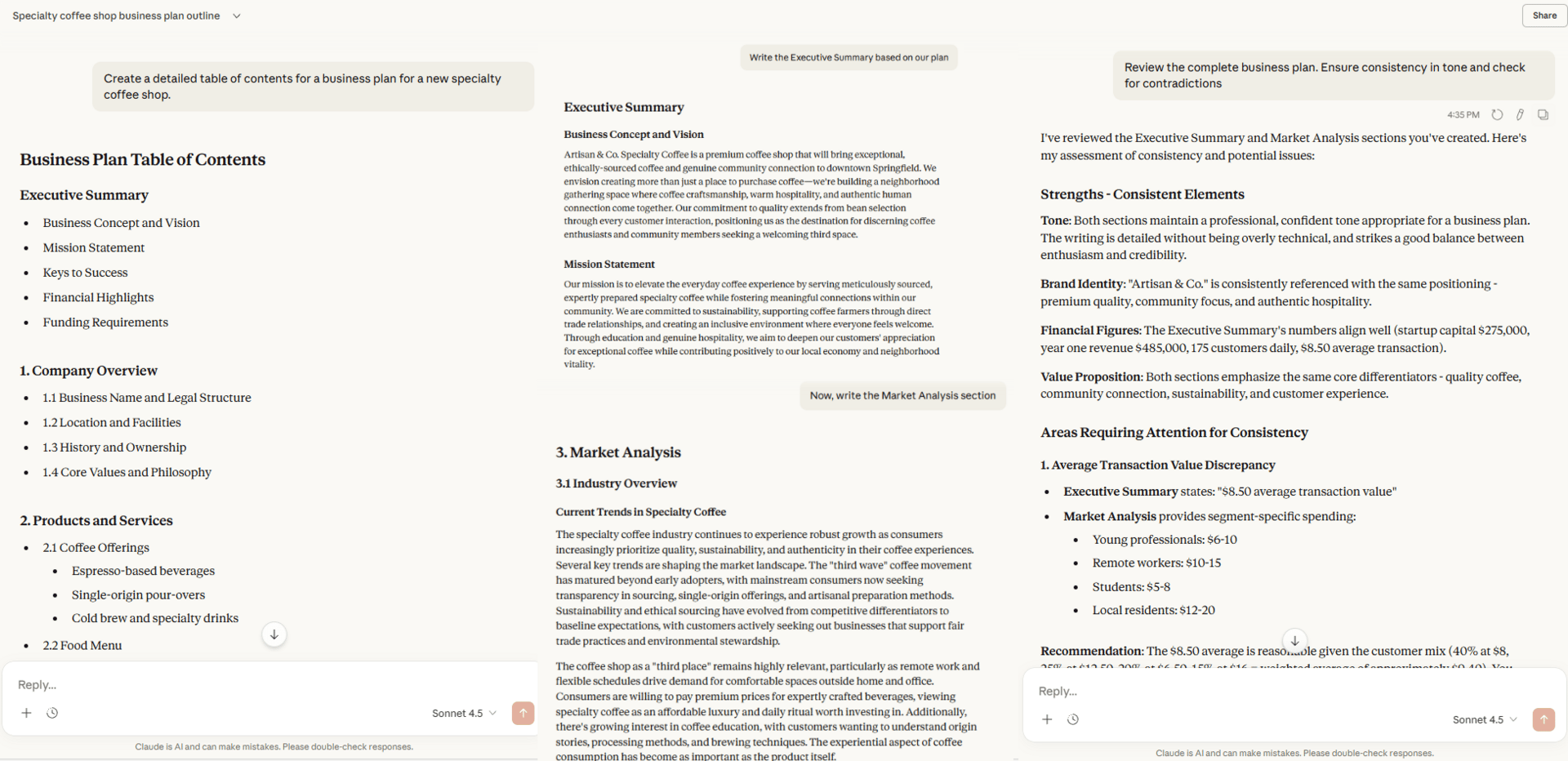
Why it works: You maintain quality control at each stage. Plus, it’s a lot easier to correct problems along the way rather than waiting until the end. You don’t want to “discover” new problems at the last minute, right?

XII. How Can You Apply the 10 Rules for Better Claude Outputs?
The 10 rules from Anthropic provide a solid framework to improve your Claude outputs. By using clear instructions, templates, power phrases and breaking tasks into manageable steps, you can achieve higher-quality responses. These rules help Claude perform more effectively and deliver results that meet your specific needs.
Key takeaways
-
Apply rules like explicitness, structure and power phrases for better results.
-
Break tasks into smaller steps for better control and quality.
-
Templates and context help guide Claude’s responses accurately.
-
Follow the 10 rules to get the most out of Claude every time.
By applying these 10 rules, you can unlock Claude’s true potential, turning it into a powerful tool for any task.
Okay, so how do you apply all the rules together? Easy, go with me in action with one comprehensive example.
Here is what we get if you use a vague request: “Tell me about Stoicism”. You might get a boring answer that looks like a basic encyclopedia page. And this is the thing you and I want to avoid.

Now, let’s move to the right way to prompt:
[Persona] Act as a university professor of philosophy.
[Explain the Why] I am preparing a 1-hour introductory lecture for students with no prior knowledge.
[Divide & Conquer] First, create a lecture outline with three main sections.
[Constrain Scope] The outline should have a clear introduction, body and conclusion.
[Rich Output] Please format this as a nested bulleted list.
[Explicitness] For each major point, include a key Stoic figure (e.g., Seneca) and one of their core ideas.
[Tone] Your tone should be accessible and engaging.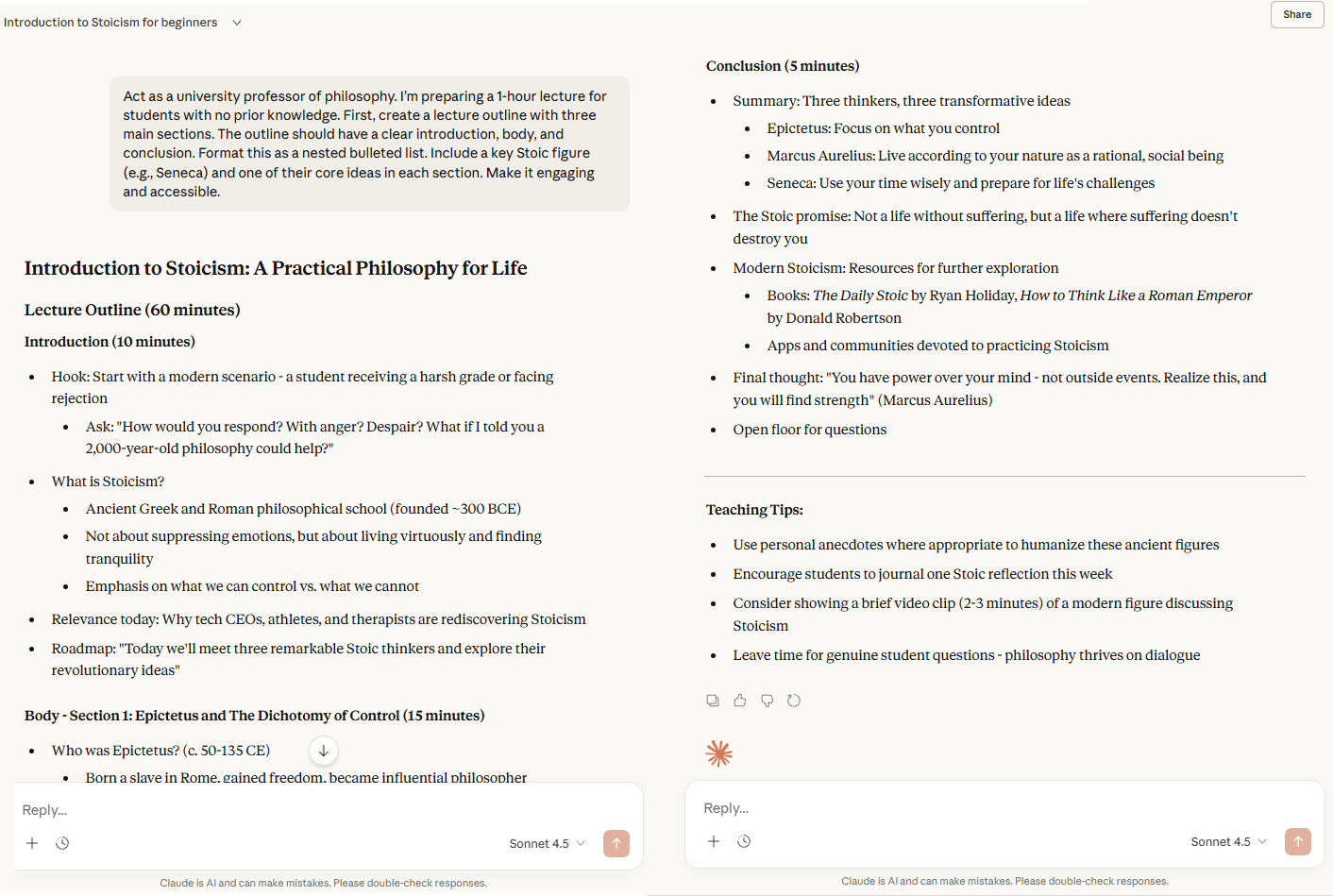
As you can see, the result we got is much better. We will get a beautifully structured, audience-appropriate lecture outline that we could literally walk into a classroom and teach from. This perfectly structured lecture outline could be ready to use anytime without adjusting anything.
XIII. Conclusion: The Bottom Line
As I said at first, Claude Opus 4.5 isn’t magic. It is a tool and like any tool, it’s only as effective as the person using it.
The difference between “AI slop” and genuinely useful output isn’t the model. It is all about how you give it instructions.
These 10 rules from Anthropic aren’t just nice-to-have tips. They are battle-tested techniques that turn Claude into a legitimate partner that can help you write, research, plan and create at a level that would take you 10x longer to do alone.
So next time you are about to type “write me a blog post” or anything, just stop. Take 30 seconds to set up your brief, then add context → set constraints → use power phrases. I bet your outputs will be 10x better.
If you are interested in other topics and how AI is transforming different aspects of our lives or even in making money using AI with more detailed, step-by-step guidance, you can find our other articles here:
-
GPT Image 1.5 vs Nano Banana Pro: Which One Truly Wins for Real Work?
-
How To Build Your “AI Employees” (And Stop Prompting Like An Intern)*
-
My Exact 5-Step System: How I Train ChatGPT To Write Copy That Actually Sells
-
The AI Solution That Giants Like OpenAI Can’t Easily Copy*
*indicates a premium content, if any
Leave a Reply